In August 2026 a 36-page question-and-answer document began circulating, setting out what Ukrainian units have learned about FPV drones and defending against them. The answers come from serving Ukrainian officers — UAV commanders between platoon and battalion level, and staff officers of the Unmanned Systems Forces — replying to a structured questionnaire. What makes it worth reading is not that it is new, but that it is written by the people doing the work, and that it says plainly which countermeasures failed.
This is not a summary of it. It isn't ours to republish, and a digest would waste the thing that makes it unusual. What follows is our reading of it.
Why it carries weight
Most counter-UAS “lessons from Ukraine” reach us third-hand, through a vendor's threat slide or a conference panel. This is closer to the source, and it is structured to stay honest: the main text gives the doctrinal picture, blocks headed addition from front-line experience give the blunter version from the people flying, and passages the editors consider volatile are flagged in red for re-verification.
It also states its own limits, which is the first thing that makes it credible. It presents itself as a summary of Ukrainian experience for understanding problems and trends — explicitly not a template to be copied onto a different front, and its annotations keep marking where other theatres differ.
But the reason it matters to anyone in the sensing business is narrower and rarer. It contains a written list of counter-drone equipment that was bought and did not survive contact. Almost nobody publishes that list.
The list has a hidden sorting principle
Read the detection chapter's two columns — what worked, what failed to justify itself — and the obvious reading is a shopping verdict. Radar disappointed against FPV: tiny radar cross-section, terrain clutter, no reliable lock. Mass networks of cheap acoustic sensors disappointed: with dozens of drones overhead they could not answer friend-or-foe, and they cost real money to blanket a sector with. On the other side, radio direction-finding worked, jamming worked, short-range personal detectors worked, and human observers — the eye by day, a thermal observer by night — worked.
That is not the interesting reading. The interesting one is that almost everything in the “worked” column works by reading something the drone is broadcasting. Direction-finding reads the control link. Jamming attacks the control link. The personal detector on a soldier's chest keys on the drone's video downlink frequency. Three of the four credited methods are the same physical channel, approached from different angles.
The front-line addendum makes this concrete when it describes how detection is actually organised: three echelons, where the first is signals intelligence plus electronic warfare, the second is personal detectors, and the third is acoustic detection plus somebody shooting. Two of the three echelons read the same channel. The third is a man listening.
Now introduce the fibre-optic drone, which spools out a physical cable and emits nothing at all toward its operator. Echelon one goes dark. Echelon two goes dark, because a fibre drone has no video transmitter for the detector to hear. What is left of a three-layer architecture is a soldier with his ears. The document's own verdict on fibre is flat: “currently only kinetic interception is effective against them” — and it notes Russia has pushed fibre ranges out far enough to reach logistics hubs well behind the line.
A second-order irony worth naming, and it is ours rather than the document's: acoustic is the modality rated a failure as a wide-area network, and also the one the architecture falls back on when fibre removes the other two — the document notes elsewhere that acoustic sensors can warn of fibre drones electronic intelligence cannot see. The failure was not the physics. It was trying to scale a low-confidence bearing into a sector-wide picture without solving classification.
That is the finding we would carry out of this document above all others. The counter-UAS market has spent five years buying sensors that require the target's cooperation, and the adversary has spent two years engineering that cooperation out of the threat.
What a defender actually has, in seconds
The document is unusually precise about the clock, and the numbers reframe what a detection system is for.
FPV drones now hold a strip roughly 15–20 km behind the line of contact under continuous fire control. Inside it, once a target is identified, a unit with enough crews begins a series of strikes about 12–18 minutes after detection, at a rate near one per minute. Against that, the document defines relevant response time — the margin actually sufficient to take cover, disperse, or bring EW to bear — and puts it, for visual and thermal detection, at tens of seconds. Personal RF detectors buy three to five minutes.
Set those against each other and a detection system stops being a targeting aid. It is a machine for converting physics into a person reaching cover — a more honest product definition than any kill claim.
The document also says directly where in the kill chain to intervene: strikes on random targets are rare, an attack is preceded by an intelligence cycle, and the easiest stage at which to defeat it is the target detection and tracking stage performed by the reconnaissance drone. Our inference: that reframes the sensing problem in a defender's favour. The terminal FPV, diving in its last seconds, is close to an unwinnable detection engagement for anything ground-based. The scout that cued it is a different target entirely — higher, slower, loitering over a sector for minutes, returning to the same patterns. A fixed sensor that cannot win against the dive can plausibly win against the loiter, and chasing the wrong one of those two is how a good sensor gets judged a failure.
Autonomy is closing the door the electronic layer was holding
The autonomy chapter is where the document's own outlook darkens. Machine-vision terminal guidance is already in serial production, with the AI taking the last 400–500 metres of flight so the strike completes under dense jamming or with the operator's link severed. The industry forecast it records is that within 6–9 months comparable target-lock autonomy could be supplied to most drones at the front. Until the operator locks on, the drone is still jammable; after that, it isn't.
The conclusion the document draws from this is the one that ought to be read twice by everybody selling electronic countermeasures: “the more autonomous the final phase of employment, the less EW helps in the final part of the flight — and therefore the weight of passive defence, camouflage and detection-avoidance rises.”
Note what that prescription is not. It is not “buy a better detector.” It is signature discipline — do not be selected as a target in the first place. Elsewhere the document is blunter still: movement, signature and behavioural discipline often save more lives than any single device.
Our inference: signature discipline has an implication for sensors that the document does not spell out. A sensor that emits is a signature. In an environment where being located precedes being killed, an active radar is a beacon at the exact moment the doctrine says stop radiating. Passive sensing stops being a specification line and becomes compliance with the document's own conclusion.
Where this reads badly for us
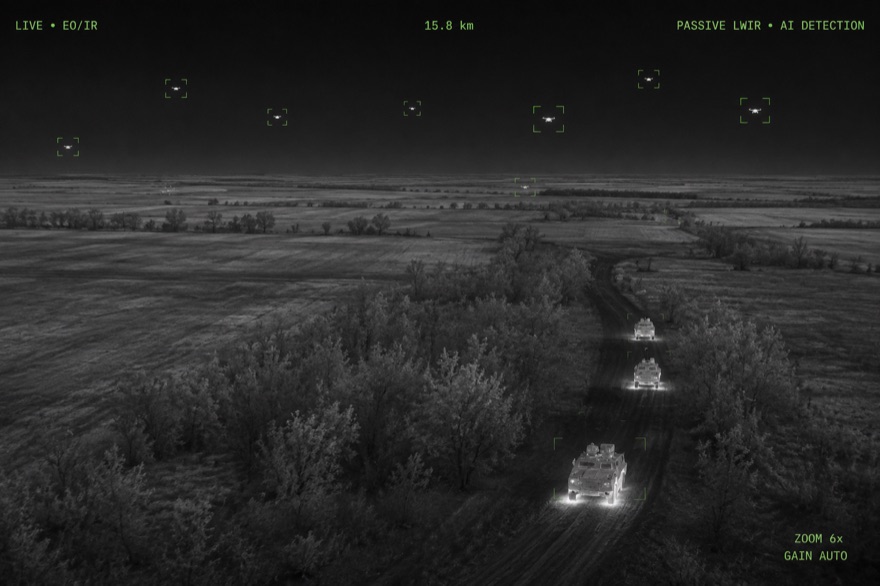
We build passive thermal detection — uncooled thermal sensors, on-device classification, fixed field nodes, SAPIENT C2 interoperability. The findings above read in our favour, and stopping there would be dishonest. Three things in this document cut the other way.
The sharpest one is about thermal. The detection chapter carries an explicit asterisk: “thermal detection of a drone works reliably only from another drone.” An infantryman scanning for a drone at night with a thermal device, it says, will most likely be killed — his own heat signature is far larger than an attack drone's, so he offers the easy target while his odds of finding it are worse than its odds of finding him. Hence the standing rule: heard a drone at night, skip the detection step and run for cover.
We read that as a statement about who carries the sensor rather than about whether thermal works, and the document supports that reading elsewhere: it observes that at night thermal cameras make movement almost impossible to hide, and that the safest movement window is the dusk gap when day cameras have failed and thermal has not yet come fully into its own. Thermal is credited there as decisive. Our inference: what fails in the asterisk is a man, under a lethal clock, spending on searching the seconds he needed for cover. An unattended node has no heat signature to trade, does not have to search, and does not tire. But the physics underneath the warning is real — an FPV is small and cool against cluttered terrain — and every range and resolution claim in this field, ours included, deserves to be met with a demand for evidence from real captures rather than a datasheet.
The second is that its failure list describes a fixed sensor network uncomfortably well. Among inadequate solutions it names single-layer defence, extensive expensive acoustic networks that cannot solve friend-or-foe, and “static positions well known to the enemy.” A fixed node is, by definition, a static position the other side gets time to learn. The only honest answers are that a node has to be cheap enough to be losable and numerous enough to be redundant, that it should not radiate, and that it should be sited like a position rather than installed like a camera. None of that makes it not static.
The third is friend-or-foe, and we should not pretend it is solved. The acoustic networks failed on discrimination at density, and a thermal net over a sector with dozens of aircraft overhead faces exactly the same question. Our claim is narrow and testable: a classifier that outputs a labelled, tracked object is a different input to a common picture than a sensor that outputs an ambiguous bearing, and correlating those tracks across nodes through a standard C2 interface is the part that turns detections into a picture. Whether that holds at wartime density is an open question. The document is evidence that nobody has closed it.
The takeaway
The Australian framing we wrote about earlier reached its conclusion — that no single sensor wins the drone war, the architecture does — from a policy conversation. This document arrives at the same summary judgement, “against FPV there is no ‘silver bullet’”, from three years of casualties, and adds the part policy documents leave out: the receipts.
Its sorting principle is the lesson. Methods that depend on the target emitting are being systematically defeated, by fibre at the link layer and by machine vision at the terminal one. Methods that depend on physics the drone cannot switch off are the residue — and the document credits them mainly in forms a defender cannot field at scale, either airborne on another drone or held by a soldier who should be running instead.
Closing that gap is a question of what carries the sensor, not which sensor it is. The line worth keeping on the wall is the document's own third point: the human in the loop and fast lesson-learning remain the central advantage, because the technological advantage keeps passing from side to side. Any vendor, ours included, who reads that as an endorsement of their box has read it backwards.
Source: “Questions and answers on the operation of FPV drones and defence against them,” August 2026, 36 pp., unclassified. Written by serving Ukrainian officers — UAV commanders from platoon to battalion level and UAV staff officers of the Unmanned Systems Forces and combined-arms formations — in reply to a structured questionnaire. This piece refers to and analyses that document; it does not reproduce it, and readers wanting its substance should obtain it through the appropriate channel. Translation of the quoted phrases, and all commentary, are GoTeam's; passages marked as our inference are our own reading and not claims of the source. Not affiliated with or endorsed by any of the above.
Building a layered counter-drone picture?
We'll scope a passive thermal layer for your site — live tracks to your hub, and a detection that doesn't need the drone to transmit.