Two years ago, a cheap quadcopter over a military base was a curiosity. Today it's a planning assumption. The war in Ukraine and the strikes across the Middle East have compressed a decade of doctrine into eighteen months, and the lesson that keeps surfacing is uncomfortable for anyone who bought their air defence in the missile era: the cheapest thing in the sky is now the hardest thing to stop.
Australia has been unusually clear-eyed about this, and two recent Defence Connect pieces capture the two halves of its answer. One is an interview with Ben Westgarth, CEO of the Canberra-based electronic-warfare firm Department 13, on layered sensing. The other is a conversation with Lee Kormany of EOS Defence Systems on making the shot cheap. Read either alone and you get half a strategy. Read them together and the architecture snaps into focus — including the part everyone underestimates.
The threat stopped being tactical
Westgarth's starting point is that drones have crossed a line from tactical nuisance to strategic weapon. They disrupt operations, they hold critical infrastructure at risk, and they routinely defeat air-defence systems that were never designed for them. Australia's 2026 National Defence Strategy and Integrated Investment Program reflect that shift, leaning hard into autonomous systems, electronic warfare, and integrated air and missile defence.
But the sharpest point in the interview is that the hard part isn't buying drones — plenty of countries can do that. The hard part is building the machinery to detect, track, and defeat them. Those are different problems, and they don't get solved by procuring one more piece of hardware.
LAND 156 and the "system of systems"
That's the thinking behind LAND 156, the ADF's counter-small-UAS program that Department 13 contributes to. Westgarth is explicit that its value isn't a single silver-bullet effector — a laser, a jammer, a missile — but the architecture that ties sensors and shooters together. Department 13's own role is radio-frequency detection: identifying and tracking drones, including encrypted ones, and handing that picture off to the rest of the network.
The reason a network beats a gadget is threat diversity. A modern battlefield mixes commercial quadcopters flying ISR, long-range one-way attack drones reaching targets hundreds of kilometres away, GPS- and AI-guided autonomous platforms, and fibre- or cable-connected drones that carry no radio link at all. No one sensor sees all of that, and no one effector defeats all of it. The only workable answer is layered — many sensing methods feeding a common picture, many response options behind it.
The cost curve that breaks everything
The most strategically important part of the interview is about money. As Westgarth puts it: "The offensive capability of a drone is still far greater than the defensive equivalent."
The numbers make the point brutally. Mass-produced Mavic-class drones and Iranian-designed Shahed attack drones cost anywhere from a few hundred to tens of thousands of dollars. The interceptors fired at them can cost millions — Westgarth notes US forces using multi-million-dollar missiles to down targets two orders of magnitude cheaper. Worse, the drones roll off a production line while the missiles carry long, complex lead times.
This is the quiet reason "layered defence" is not a slogan. Detection is cheap; the expensive kinetic layer should be the last resort, reserved for the threats that earn it. Everything upstream — sensing, classification, early warning, cueing a low-cost or non-kinetic effector — exists to keep you from spending a million dollars to solve a thousand-dollar problem.
Australia's other half: make the shots cheap
If the cost curve is the problem, Australia is already funding an answer to it at the other end of the chain. In July 2026 the federal government put $5.7 million behind EOS Defence Systems to develop the R400 SLINGER counter-UAS capability, under the Advanced Strategic Capabilities Accelerator's Mission Syracuse. EOS took an existing R400 remote weapon station and re-engineered it into a drone-killer — a fast, pragmatic adaptation rather than a decade-long clean-sheet program. That speed is itself the point: capability has to arrive at the pace the threat is evolving, not a procurement cycle later.
The more consequential thread, though, is directed energy. Lee Kormany, executive vice president of EOS Defence Systems Australia, frames high-energy lasers as increasingly central to modern operations — and the reason is arithmetic. A missile costs millions; a gun round costs dollars; a laser shot costs pennies of electricity. Against a threat that arrives as a swarm of $1,000 airframes, cost-per-engagement is the whole war. Directed energy is the first effector class that flips the exchange ratio back toward the defender.
You can't out-iterate a software product
Traditional platforms take decades to field. Drones take a weekend. They're software-driven and trivial to modify, and, in Westgarth's words, a minor change can produce a major capability jump for almost no effort. Chasing specific models or specific vulnerabilities is a treadmill — the "cat-and-mouse game" his team decided early on was futile.
Their alternative is worth internalising: instead of targeting individual drones, target the things every drone must do. Every drone senses its environment. Every drone depends on some enabling technology to be useful. Build your counter-systems against those invariants and they stay relevant as the airframes churn.
The blind spot layering is supposed to cover
Here's where the layered-defence argument has to be taken to its honest conclusion — and where an RF-first strategy quietly names its own limit.
Department 13 does radio-frequency detection extremely well, and RF is a superb first layer: it's passive, long-range, and it identifies the operator as well as the aircraft. But the same interview lists two threat classes that emit little or no RF to detect — fully autonomous drones navigating by GPS or onboard AI image recognition, and fibre-optic or cable-connected drones that carry no radio link at all. Ukraine is now fielding both at scale precisely because they defeat RF-based defences.
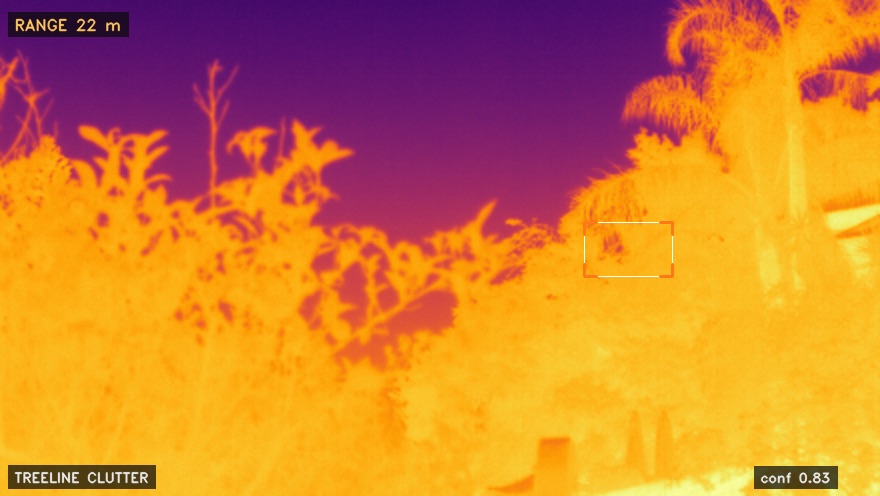
An RF sensor cannot see a target that doesn't transmit. That's not a criticism of RF — it's the entire reason the doctrine is layered. A credible counter-UAS picture needs at least one sensing method that doesn't depend on the drone cooperating by emitting a signal. Passive electro-optical and thermal (EO/IR) detection is that method: it sees the aircraft by its own heat and form, whether it's screaming on a control link or running silent on autopilot. Radar adds another independent layer; acoustic adds another still.
The point isn't that any one of these — thermal included — is complete. Thermal has its own honest limits: weather, range, and resolution all constrain it, which is exactly why it belongs in a layer rather than sold as a standalone answer. The strategic insight from Australia is that resilience comes from overlapping, independent detection modalities whose blind spots don't line up. RF misses the silent drone; the thermal camera sees it. The thermal camera struggles in fog; radar carries the track. That redundancy — not any single sensor — is the defence.
A shooter is only as good as what cues it
Put the two halves together and the architecture snaps into focus. Australia is buying the defeat layer — SLINGER, lasers, effectors that can finally trade favourably against a cheap drone. But an effector cannot engage what it was never told about. A high-energy laser has a narrow beam and needs a precise, continuously updated bearing, elevation and range to stay on a moving aimpoint long enough to burn it. A remote weapon station needs a track to slew onto. Every one of those numbers is an output of the sensing layer.
Which is why the blind spot matters more as effectors get better, not less. A directed-energy weapon cued only by RF inherits RF's blindness — the autonomous and fibre-optic drones walk straight through the beam's field of regard because nothing ever handed it a track. The cheapest way to waste an effector program is to feed it a sensor picture with a known hole in it.
Beyond the battlefield
Westgarth is right that the problem isn't confined to the front line. Energy grids, ports, industrial sites, government facilities, resource projects — the same cheap aircraft threatens all of them, and protecting them takes early warning, rehearsed procedures, and hardened physical security working together. For a country like Australia, "critical infrastructure protection" and "counter-UAS" are converging into the same discipline. The rest of the world is close behind.
Australia's real advantage
The interview closes on an optimistic and, frankly, correct note: Australia's geography is a strategic asset. Vast, sparsely populated space is a rare thing — an open-air range where new drones and new counter-systems can be built and tested at scale, across environments from dense city to open desert to long coastline. Capability proven across that range travels well to similar environments worldwide. Few nations can develop and validate this technology the way Australia can.
The takeaway
The race is no longer about building drones fast and cheap — everyone can now do that. It's about building the systems that defeat them. That means treating counter-UAS as an integration problem, not a shopping list: layered sensing where each modality covers another's blind spot, a common operating picture, and a graduated set of responses that keeps the expensive kinetic option for last.
Australia's LAND 156 and Mission Syracuse are serious steps toward that model — one buying the picture, the other buying an affordable shot. The lesson for everyone else is simpler than either program: stop asking which sensor wins the drone war. None of them do. The architecture does.
Passive thermal is the layer we build — the one that still sees the drone when it stops transmitting. If you're assembling a layered picture and want to see it running on real hardware, with real detections rather than a slide: goteam.co.il/management.html
— Baruch
Sources: Robert Dougherty, “Winning the drone war: Australia's counter-UAS future revolves around layered defence strategy,” Defence Connect — Autonomous & Uncrewed 2026, interview with Ben Westgarth, CEO, Department 13. · “SPOTLIGHT: Counter-drone innovation, directed energy and delivering operational outcomes, with EOS Defence Systems' Lee Kormany,” Defence Connect Spotlight podcast, 14 July 2026 (host Robert Dougherty). Note: this is independent commentary by GOTEAM. We are not affiliated with, sponsored by, or endorsed by Defence Connect, Department 13, or EOS Defence Systems, and the analysis of RF's limits is our own reading of the public material — not a statement by any party quoted.
Building a layered counter-drone picture?
We'll scope a passive thermal layer for your site — live tracks to your hub, and a detection that doesn't need the drone to transmit.