Key takeaways
- MarketsandMarkets forecasts counter-UAS spending of USD 9.17 billion in 2026, rising to USD 29.70 billion by 2031.
- No single sensor covers every drone. Plan for two or more layers.
- Buy detection and mitigation separately. In some jurisdictions only specific government agencies may jam, spoof or defeat a drone. Check with counsel first.
- Ask how every vendor number was measured: which drone, range, weather and hours.
- Pilot on your own site, with test flights and a written scoring plan, before a multi-site contract.
Why are organisations buying counter-UAS now?
The money and the threat changed at once.
MarketsandMarkets' July 2026 release names two drivers: drone swarms, which need systems that detect, track and mitigate several drones at once, and government funding. It expects mitigation and neutralisation to grow fastest.
Drones also got harder to sense. Fibre-optic FPV drones in Ukraine fly over a cable, "in total radio silence" in one commander's words (The War Zone); so does a drone on a pre-programmed route. The US Cybersecurity and Infrastructure Security Agency (CISA) says in its November 2025 guidance: "Non-RF emitting UAS generally cannot be detected by RF systems." So ask not only how far a system sees, but which drones it sees at all, and how many at once.
What does each detection layer miss?
CISA groups detection sensors into radio frequency (RF), radar, electro-optical/infrared (EO/IR) and acoustic, plus Remote ID receivers. Each senses a different signal, so each fails differently.
| Layer | What it senses | Strong at | Misses or struggles with | Emits? |
|---|---|---|---|---|
| RF detection | The drone-controller radio link | Generally longer range than EO/IR and acoustic; no line of sight needed; some locate the operator | Drones that do not transmit (fibre-optic, pre-programmed, autonomous); needs signature libraries for make and model | No |
| Radar | Echoes of its own radio waves | Generally the longest range; less affected by weather than EO/IR or acoustic | Needs line of sight; can be degraded by congested RF; a track, not a picture; in the US, likely needs authorisation to transmit | Yes |
| EO/IR cameras | Light and heat from the airframe | Sees non-emitting drones; imagery an operator can check | Needs line of sight; weather degrades the image; field of view can be limited | No |
| Acoustic | Rotor and propeller noise | Sees non-emitting drones | Shorter range; ambient noise and weather reduce performance | No |
| Remote ID receivers | The drone's identification broadcast | Phone apps available; can show operator or take-off location | Depends on operator compliance; can be spoofed; in the US, drones under 250 g are generally exempt unless flown commercially | No |
Strengths and limits summarised from CISA's November 2025 guidance. The "Emits?" column describes the sensing technique.
CISA therefore advises a "system of systems": two or more sensor types, with sensor fusion to reduce detection errors.
Staring, scanning or PTZ?
For cameras, how the sky is covered matters as much as the sensor.
| Optical design | How it covers the sky | Time between looks at one bearing | Needs a cue? | Main trade-off |
|---|---|---|---|---|
| Fixed staring cameras | Fixed wide-field cameras, one per sector | One frame | No | More cameras for 360°; fewer pixels per degree, so less range per camera |
| Scanning panoramic imager | One head or mirror sweeps the horizon | One full scan | No | High resolution per degree; each bearing revisited once per scan |
| Pan-tilt-zoom (PTZ) | One narrow view pointed at a target | Not applicable: it watches only where it points | Usually, from radar or RF | Excellent for identification once cued; cannot search a wide sky quickly when zoomed in |
The longer the gap between looks, the harder a tracker finds it to match new detections to existing tracks, especially for fast drones and swarms (arithmetic in Blink and It's Over). A common design pairs fixed sensors for detection with a cued zoom camera for identification.
Cooled MWIR or uncooled LWIR?
Cooled mid-wave infrared (MWIR) reaches farther; uncooled long-wave infrared (LWIR) is smaller, cheaper and uses less power. In our published assessment, cooled MWIR costs 10 to 50 times more, draws far more power, depends on a cryocooler with a limited service life, and is often export-controlled. For detection well beyond the range at which you can act, cooled may be right; for many sensors around a perimeter, per-sensor cost and power decide.
Detect or mitigate: what can you legally do?
Buy detection, tracking, identification and mitigation as separate decisions, even when sold as one package. Mitigation means jamming, spoofing, taking control, or physical means such as nets. CISA draws the same line: detection is not counter-UAS, and can be used on its own.
The law treats them very differently, and rules vary by country. In the US, a 2020 interagency legal advisory (DOJ, DHS, FAA and FCC) states that Congress authorised only the Departments of Defense, Energy, Justice and Homeland Security to carry out limited detection and mitigation against drones threatening covered facilities. Others, including critical-infrastructure operators, stadiums and airports, may face federal criminal laws if they use mitigation. Even some detection systems can raise surveillance-law questions; CISA recommends consulting legal counsel before buying or deploying detection.
This is not legal advice, and laws change. Ask your counsel what you may lawfully do at each site before you write requirements. Many private operators buy detection, tracking and identification, then hand the result to the authority allowed to act.
What belongs on your evaluation checklist?
Score proposals side by side on these twelve points.
- Radio-silent drones. Which layer detects a fibre-optic, pre-programmed or autonomous drone?
- Swarms. How many tracks at once, how often is each updated, and how long is any bearing unwatched?
- False alarms. CISA warns that a high false-positive rate causes "alert fatigue." Ask for false alarms per day at a named site, over a stated period, with birds, clouds and traffic in view.
- Range tied to a target. Which drone size, weather and probability of detection? Detection and stable-track range separately.
- Cueing. Does any sensor need another to tell it where to look, and what happens when that one misses?
- Emissions. CISA notes that in the US radar is likely to need authorisation, and that some detection systems emit radiation that can harm people or disrupt aircraft systems.
- Open interfaces. Can it report into your command-and-control (C2) without a proprietary gateway? SAPIENT, published as BSI Flex 335, has been adopted by the UK Ministry of Defence as its counter-UAS standard. CISA notes that siloed systems increase operator task saturation.
- Export controls. Is any component under ITAR or other controls? Licensing affects schedule before technology.
- Total cost. Sensors, masts, power, network, installation, subscriptions, maintenance and calibration. Gimbals and cryocoolers wear out.
- Reviewable evidence. Can operators see the imagery behind an alert, and reprocess past detections when the software improves?
- Signature libraries. How often are they updated, and do they work across manufacturers? CISA raises both points.
- Supply chain. Software and hardware bills of materials (SBOM, HBOM)? Who can physically access the units?
What should you ask vendors?
Turn the checklist into written questions, and add these:
- "Show us a detection with the drone's radio link off. Which sensor produced it?"
- "What does year three cost, including support, subscriptions, spares and recalibration?"
- "Can our operators replay the data behind every alert from the last 30 days?"
- "Which detections did your system miss in your last field trial, and why?"
The last is the most useful: a vendor that knows its failure modes has measured them.
How do you run a pilot that tells you something?
A demonstration shows a system can work; a pilot shows whether it works at your site.
- Write the threat and scoring plan first: drone types, approach routes, protected area, and how you will score detection, tracking and false alarms.
- Measure the background first. Run several days with no test drones up; every alert is then a false alarm or an unknown aircraft.
- Fly cooperative drones with GPS logs as ground truth: the named types, including small ones, at several ranges, altitudes and headings, against open sky and clutter such as treelines, roofs and cloud.
- Include the hard cases: night and poor weather if in your threat model; where lawful and safe, a pre-programmed route with the controller link off, and several drones at once.
- Score with numbers: probability of detection against range, time to first alert, track duration, false alarms per day.
- Test the integration: alerts into your C2 or video management system, worked by your own operators.
- Keep the raw data to re-score it or compare vendors on the same flights.
Check local aviation rules before flying test drones, especially near airports or restricted airspace.
Where does passive thermal staring fit?
This is our layer, so read this section with that in mind.
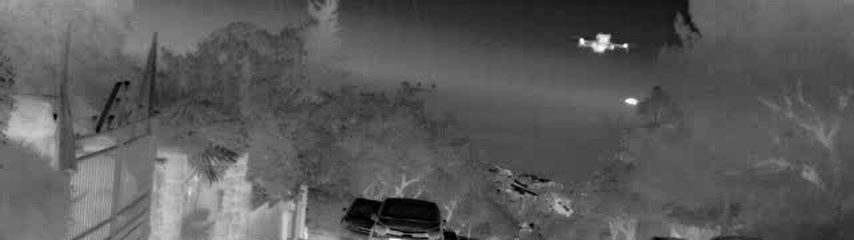
GOTEAM builds passive, AI-based thermal detection. Fixed uncooled thermal nodes image their whole field of view every frame, with detection on an edge computer at the sensor, so it works offline. The sensor does not transmit: no spectrum licence, and the target cannot jam or geolocate it. It detects by heat and shape, so fibre-optic and autonomous drones are as visible as radio-controlled ones. Each confirmed track comes with an annotated video clip, reported over SAPIENT (BSI Flex 335 v2) to third-party C2. GOTEAM does detection and identification only: it does not jam, intercept or shoot down drones. It is ITAR-free; the uncooled core is EAR-controlled, and international engagements remain subject to Israeli export-control review.
The limits are real. We publish detection up to 400 m, a target- and scenario-dependent figure. A thermal node needs line of sight and is affected by weather; 360° takes several cameras; and range is estimated from the image, not measured as radar does. Pair it with RF and radar for reach, and a cued zoom camera for identification.
To test the detection layer first, upload your own thermal or EO clip to FlyBox; a GOTEAM field device returns an annotated result.
Frequently asked questions
What is the difference between drone detection and counter-UAS?
Detection finds, tracks and identifies a drone. Counter-UAS in the full sense adds mitigation: jamming, spoofing, taking control or physically stopping it. CISA treats them as distinct.
Which drone detection technology is best?
None on its own. Each sensor type misses different drones, so CISA recommends combining two or more with sensor fusion.
Can RF detectors find fibre-optic or autonomous drones?
Generally not, as CISA states. Radar, EO/IR and acoustic sensors can detect them, within their own limits.
Do I need a licence to run a counter-drone sensor?
It depends on the sensor and the country. Radar transmits, so in the US it is likely to need authorisation; passive thermal cameras do not transmit. RF detectors may raise surveillance-law questions. Ask your counsel about each site.
Can a private company jam or take down a drone?
In many places, no. In the US, a 2020 interagency advisory reserves that authority for specific federal departments and warns that others may face federal criminal laws. Get legal advice before buying any mitigation capability.
How should I compare vendors' detection range claims?
Ask which drone, size, weather and probability of detection each figure refers to, and whether it is first detection or a stable track. Then measure it in a pilot on your site.
What false-alarm rate is acceptable?
As many as your operators can handle without alert fatigue, which CISA warns about. Ask for false alarms per day at a comparable site, measured over days, not minutes.
What is SAPIENT, and why does it matter?
A sensor-to-C2 interface standard owned by the UK Ministry of Defence, published as BSI Flex 335 and adopted by the MOD for counter-UAS. An open interface makes it easier to add or replace sensors later.
Is uncooled thermal good enough, or do I need cooled MWIR?
It depends on range. Cooled MWIR sees farther but costs more, uses more power and is often export-controlled. Uncooled LWIR suits dense perimeter coverage at shorter range. Match the sensor to the distance at which you can respond.
How long should a counter-UAS pilot run?
Long enough for several days of background false-alarm measurement with no flights, plus planned cooperative flights at different ranges, times of day and weather. A one-afternoon demo shows neither.
- MarketsandMarkets, "Counter-UAS System (C-UAS) Industry worth $29.70 billion by 2031," press release, 17 July 2026. https://www.marketsandmarkets.com/PressReleases/counter-cuas-systems.asp
- CISA, "Unmanned Aircraft System Detection Technology Guidance for Critical Infrastructure," November 2025. https://www.cisa.gov/sites/default/files/2025-10/DetectionTech_20251030_508.pdf
- US DOJ, DHS, FAA and FCC, "Advisory on the Application of Federal Laws to the Acquisition and Use of Technology to Detect and Mitigate Unmanned Aircraft Systems," 17 August 2020. https://www.dhs.gov/publication/interagency-legal-advisory-uas-detection-and-mitigation-technologies
- The War Zone, "Inside Ukraine's Fiber-Optic Drone War," 28 May 2025. https://www.twz.com/news-features/inside-ukraines-fiber-optic-drone-war
- UK Government, "SAPIENT autonomous sensor system." https://www.gov.uk/guidance/sapient-autonomous-sensor-system
Independent commentary by GOTEAM. Not affiliated with or endorsed by any organisation named above. Nothing in this article is legal advice.
Evaluating counter-UAS for a site?
We build passive thermal detection for sites that need a track without waiting for the drone to transmit. Ask for a specifications-first conversation about your site and threat.