In short
- Drone attacks now arrive as many objects from several directions at once, and as single fast drones that turn.
- PTZ cameras and scanning panoramic imagers look in turn, leaving each direction unwatched until they return.
- Between looks a fast drone can move many degrees and turn, and a swarm can outpace the revisit cycle, breaking tracks and delaying confirmation.
- A scanner has less time on each target to tell a drone from a bird or a cloud. A staring sensor watches every direction, every frame.
- Staring needs more cameras for 360° and has less range per pixel, so pair fixed staring sensors for detection with a cued zoom camera for identification.
Count the drones in the large attacks of the last three years. On 9 January 2024, US Central Command reported that a single Houthi attack in the Red Sea involved 18 one-way attack drones, two anti-ship cruise missiles and one anti-ship ballistic missile (Al Jazeera, citing CENTCOM). Iran's attack on Israel in April 2024 reportedly included around 170 drones along with cruise and ballistic missiles (CSIS). On the night of 8–9 July 2025, Ukraine's air force reported 728 Shahed-type and decoy drones (Military.com).
Long-range air defence handled most of those, not the short-range electro-optical sensors this post is about. But the threat now arrives as many objects, from several bearings, at once. Should the optical layer watch the whole sky all the time, or one part, then the next?
This post argues that the second approach, sequential looking, is a poor fit for the primary detection layer against swarms. The pan-tilt-zoom (PTZ) camera and the scanning panoramic thermal imager both work this way. Both are good products for their jobs, and the scanners are serious counter-UAS sensors; the argument is about physics and architecture, not product quality.
Two ways to look at the sky
A staring sensor points fixed optics at a fixed piece of sky and reads every pixel in every frame; to cover more sky you add sensors. A sequential sensor moves its field of view: a PTZ camera slews and zooms to a point of interest, and a scanning panoramic imager rotates its head, or a mirror, building a 360° image from strips.
What matters is the revisit interval: how long a direction goes unwatched between looks. For a staring sensor it is one frame period; for a sequential sensor, however long it takes to come back.
PTZ: a follow-up sensor, not a search sensor
A heavy-duty Axis PTZ, the Q6225-LE, gives a horizontal field of view of 63.8° at the wide end and 2.2° at the narrow end, with pan speeds up to 150°/s (Axis datasheet). FLIR's Ranger HDC MR, a defence surveillance system, has a cooled thermal channel with a 3.0° × 1.7° narrow field of view on one model, on a pan-tilt unit rated at up to 120°/s (FLIR Ranger HDC MR datasheet). We use both only as typical examples.
A small drone at useful range needs the narrow end. Searching a band 360° wide and 20° high at the narrow end (the dwell time is an illustrative assumption; neither datasheet gives settle or refocus times):
- Axis Q6225-LE at 2.2° × 1.3°: 164 columns × 16 rows ≈ 2,600 positions.
- Ranger HDC at 3.0° × 1.7°: 120 columns × 12 rows = 1,440 positions.
- At an assumed 0.5 s per position (slew, settle, one look), a full sweep takes about 22 minutes and 12 minutes respectively. Even at 0.1 s, the first takes over four minutes.
- In four minutes, a drone at an illustrative 30 m/s covers about 7 km.
So a zoomed PTZ cannot search; it can only look where something else tells it to. Zoomed out to 63.8°, it is a fixed wide-angle camera with a motor attached.
Cueing is the dependency. PTZ cameras in counter-UAS are usually cued by radar or radio-frequency (RF) detectors. CISA's 2025 guidance says "non-RF emitting UAS generally cannot be detected by RF systems" (CISA). Fibre-optic FPV drones, now used in large numbers in Ukraine, operate in what one Ukrainian commander called "total radio silence" (The War Zone). Radar fails too: in October 2024, a Hezbollah drone that struck a base near Binyamina was tracked by Israeli radars, then dropped off the radar, likely because it flew very low (Times of Israel). A cued camera sees nothing the cueing sensor missed.
One target at a time. A PTZ has one line of sight. With more objects than cameras, Axis's radar-cued autotracker "tracks the closest object" (Axis Radar Autotracking for PTZ manual): a sensible choice, and the swarm problem in five words. A pure 180° slew takes 1.2 s at 150°/s or 1.5 s at 120°/s, before acceleration, settling, refocusing or re-acquisition, and meanwhile the last target has no track.
Mechanics. We have no published PTZ failure-rate data, so the point is architectural: if one camera is a site's only optical sensor, its motor and line of sight are a single point of failure.
Scanning panoramas: better, but still sequential
Scanning panoramic thermal imagers fix PTZ's coverage problem by rotating continuously and stitching a 360° image, and vendors market them for counter-UAS and swarms. HGH's 2025 Spynel leaflet describes "scanning the panorama at 360°" with a frame rate of "up to 2 Hz", 360° scan rates from 0.25 Hz to 2 Hz by model, panoramic resolutions up to 92,000 × 1,280 pixels, and vertical fields of view of 5°–20° for the S and X lines (HGH Spynel leaflet). HGH's drone case study recommends a 2 Hz, 20° configuration that tracks "an unlimited number of targets" (HGH drone case study).
Third Eye's MeduzaX "covers 360° in seconds" and lists the objects it can handle as "Unlimited" (Third Eye MeduzaX brochure, 2024; MeduzaX 2025 brochure). It publishes no revisit figure beyond "in seconds" that we found, so the numbers below use HGH's rates and labelled examples.
"Unlimited targets" is a fair software claim. The limit is that a scanner updates each track at most once per rotation. The table is simple arithmetic for an illustrative drone at 30 m/s crossing at 1 km, about 1.7° per second across the view.
| Revisit | Time between looks | Drone moves between looks | Looks in a 10 s window |
|---|---|---|---|
| 0.5 Hz scan | 2 s | ≈ 60 m, ≈ 3.4° | 5 |
| 2 Hz scan | 0.5 s | ≈ 15 m, ≈ 0.86° | 20 |
| Staring sensor, 30 frames/s | 0.033 s | ≈ 1 m, ≈ 0.06° | 300 |
Three consequences follow, all worse with swarms.
Track association. Between looks the tracker must match new detections to old tracks. Two drones 20 m apart at 1 km are about 1.1° apart, and at a 0.5 Hz revisit each moves further than that between looks. With a dozen manoeuvring in one sector, swapped or broken tracks become likelier: the larger the update gap relative to target spacing, the harder association gets.
The fast, manoeuvring drone. One fast drone that turns is enough. A tracker predicts the next position from course and speed. An illustrative drone at 30 m/s, crossing 300 m away, moves about 5.7° per second: about 11° between looks at 0.5 Hz, about 3° at 2 Hz. If it turns or dives in between, it reappears far from the prediction: same drone, new drone, or noise? A staring sensor at 30 frames/s sees it move about 0.2° per frame and watches the turn. Faster, closer, harder-turning drones widen the gap, and they matter most in the last seconds.
Time on target decides verification. A scanner spends a fraction of its time on any one bearing; a staring sensor spends all of it. Telling a drone from a bird, a cloud edge or a warm roof takes evidence over time: frame-to-frame brightness flicker, whether the shape holds, motion against the background. A staring sensor gathers it continuously on every target; a scanner assembles it from glimpses a revisit apart. All else equal, staring verifies more reliably and sooner, and a drone that manoeuvres, drops behind clutter or dives late gives a scanner fewer chances to see it at all.
Confirmation versus delay. Systems usually confirm a target by seeing it over several looks, since noise, birds and clutter tend not to persist and drones do (our inference, not a vendor figure). Fewer looks per second means confirming on fewer looks, with more false alarms, or waiting longer. We are not claiming any named scanner has a high false-alarm rate; Third Eye publishes its own low figures, which we have not tested. A lower update rate narrows the margin between false alarms and latency.
HGH lists faster sector scan rates, such as 2.5 Hz on a 90° sector for one Spynel-M model, but that gives up the full panorama a multi-bearing swarm needs.
Where these sensors are the right tool
A PTZ is the right tool for identification after detection: zoomed onto a confirmed track, it lets an operator classify the airframe, see the payload, capture evidence and decide on a response. Axis sells that pairing, with a fixed thermal camera steering the PTZ "without compromising detection coverage since the fixed camera maintains vigilance" (Axis Perimeter Defender PTZ Autotracking). That is the architecture we recommend: fixed sensors detect, the PTZ identifies.
A scanning panorama wins on angular resolution: 92,000 pixels across 360° is about 256 pixels per degree, giving longer range per pixel and earlier warning of slower, distant targets.
HGH's case study says radar, PTZ and RF have "all disappointed, when used as a single technology" (HGH). CISA likewise recommends a "system of systems" with sensor fusion (CISA).
The alternative: persistent staring coverage
We cover the sky with fixed, overlapping, wide-field thermal cameras, each watching its sector every frame. An uncooled 640 × 512 thermal core behind a 14 mm lens covers about 32° horizontally at up to 60 Hz. Detection and tracking run on the node, which reports to a hub and over SAPIENT (BSI Flex 335), the counter-UAS standard the UK MOD adopted (UK Government).
- No unwatched direction. Every covered bearing is imaged every frame.
- Many tracks at frame rate. A drone moves about a pixel between updates, not dozens.
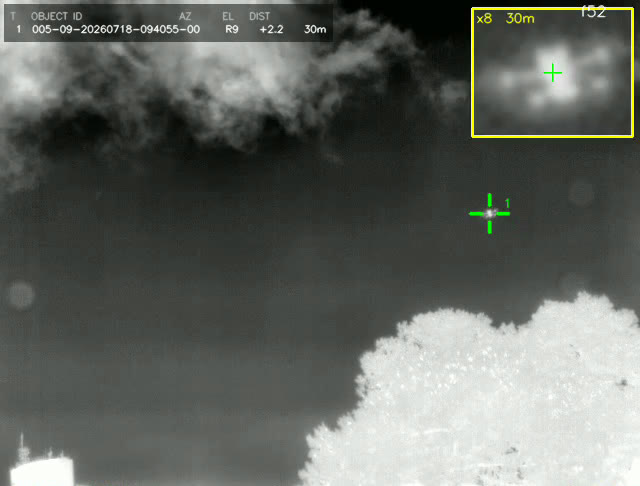
- No dependency on cooperation. A thermal camera sees a drone by its heat and shape, including fibre-optic and pre-programmed drones. CISA notes that EO/IR sensors "can detect non-RF emitting UAS".
- Graceful failure. Losing one camera uncovers one sector, not the site, and nothing in the optical path moves.
- A clean handoff. A staring track is the cue a PTZ needs, and SAPIENT carries it to whatever fusion node and effector sit behind it.
What staring costs, honestly
Many cameras. At 32° each, a 360° ring needs at least 12 with no overlap, more with overlap or a taller band: more units to site, power and maintain than one rotating head.
Shorter range per pixel. 640 pixels across 32° is about 20 pixels per degree; the Spynel models above range from about 32 to 256. A staring camera sees a drone across fewer pixels and detects it later, so a high-resolution scanner can see a slow, distant scout first.
Less sensitivity. Uncooled cores are less sensitive than cooled MWIR, the price of small, low-power nodes.
No identification at range. A few pixels say "drone-like object, here, moving like this", not always which drone. That is why the zoom camera sits behind the staring layer.
Against fast, many-bearing, swarm-style attacks inside a few kilometres, we think persistence matters more than per-pixel range. Against a single slow target at long range, the trade can go the other way.
The takeaway
PTZ and scanning panoramas look at the sky one piece at a time. That works when targets are few, slow or cued, and struggles when many arrive at once, from several directions, quickly and without emitting.
Detect with sensors that never look away. Identify with sensors that can zoom in. Put both on one common picture, because no single sensor wins the drone war.
- Al Jazeera, "US, UK forces shoot down 21 drones and missiles fired by Houthis," 10 Jan 2024 (citing US CENTCOM) — https://www.aljazeera.com/news/2024/1/10/us-uk-forces-shoot-down-21-drones-and-missiles-fired-by-houthis
- CSIS, "The Iran-Israel Air Conflict, One Week In" — https://www.csis.org/analysis/iran-israel-air-conflict-one-week
- Military.com, "Russia Launches Another Record Drone Attack on Ukraine, Ukrainian Officials Say," 9 Jul 2025 — https://www.military.com/daily-news/2025/07/09/russia-launches-another-record-drone-attack-ukraine-ukrainian-officials-say.html
- Axis Communications, AXIS Q6225-LE PTZ Camera datasheet — https://www.axis.com/dam/public/9c/fc/c6/datasheet-axis-q6225-le-ptz-camera-en-US-388304.pdf
- Teledyne FLIR, Ranger HDC MR datasheet (distributor-hosted copy) — https://www.atline.pl/images/design/pdf/FLIR-Ranger-HDC-MR.pdf
- CISA, "Unmanned Aircraft System Detection Technology Guidance for Critical Infrastructure," Nov 2025 — https://www.cisa.gov/sites/default/files/2025-10/DetectionTech_20251030_508.pdf
- The War Zone, "Inside Ukraine's Fiber-Optic Drone War" — https://www.twz.com/news-features/inside-ukraines-fiber-optic-drone-war
- Times of Israel, "4 soldiers killed in drone strike named, as families ask why there was no warning siren," Oct 2024 — https://www.timesofisrael.com/4-soldiers-killed-in-drone-strike-named-as-families-ask-why-there-was-no-warning-siren/
- Axis Communications, AXIS Radar Autotracking for PTZ, user manual — https://help.axis.com/en-us/axis-radar-autotracking-for-ptz
- Axis Communications, AXIS Perimeter Defender PTZ Autotracking — https://www.axis.com/products/axis-perimeter-defender-ptz-autotracking
- HGH Infrared Systems, "Spynel Series — Wide Area Surveillance Solutions" leaflet, 2025 — https://hgh-infrared.com/wp-content/uploads/2025/10/Leaflet_Spynel-Series_2025_LR.pdf
- HGH Infrared Systems, "Case Study — Spynel IR Camera: A Proven Solution for Drone Swarms" — https://hgh-infrared.com/wp-content/uploads/2025/01/HGH_CaseStudy_Spynel_DroneUAVDetection.pdf
- Third Eye Systems, "Meet the MeduzaX" brochure, 2024 — https://thirdeye-systems.com/wp-content/uploads/2024/06/Meet_the_MeduzaX.pdf
- Third Eye Systems, MeduzaX brochure, 2025 — https://thirdeye-systems.com/wp-content/uploads/2025/11/MeduzaX_2025.pdf
- UK Government, "SAPIENT autonomous sensor system" — https://www.gov.uk/guidance/sapient-autonomous-sensor-system
Independent commentary by GoTeam. Not affiliated with or endorsed by any organisation named above. Product specifications are quoted from each manufacturer's own published material and have not been independently tested. Figures labelled illustrative or arithmetic are ours, not the manufacturers'. Our reading of how sequential sensors behave against swarms is analysis, not a measured comparison of the named products.
Working the counter-drone problem?
We build passive thermal detection for sites that need a track without waiting for the aircraft to transmit.