In short
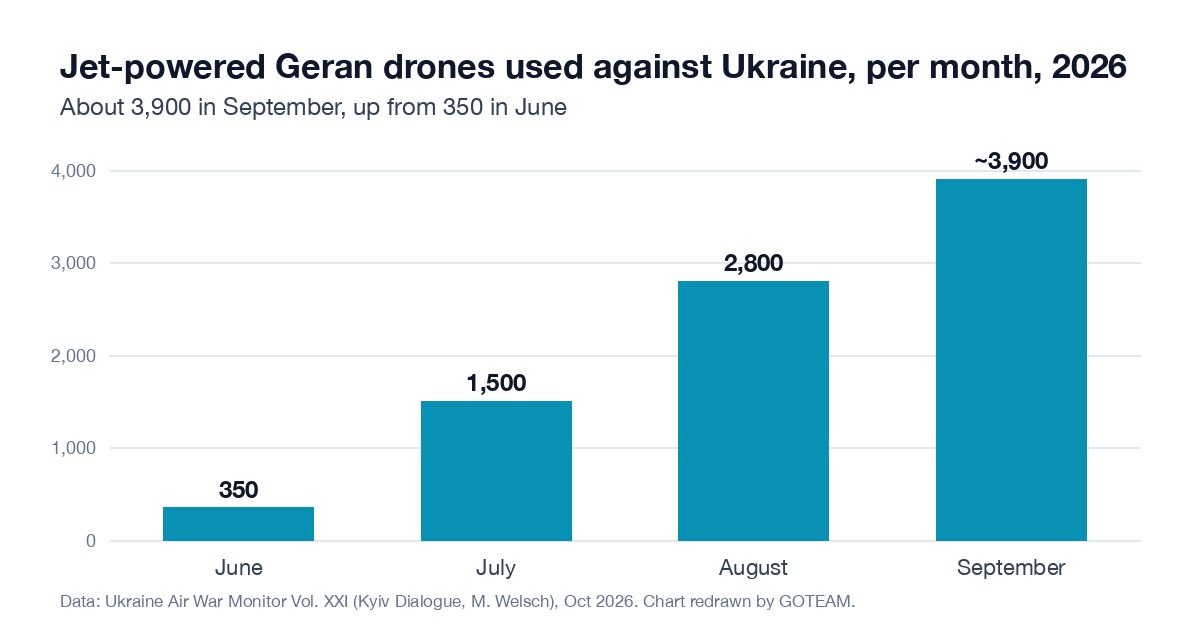
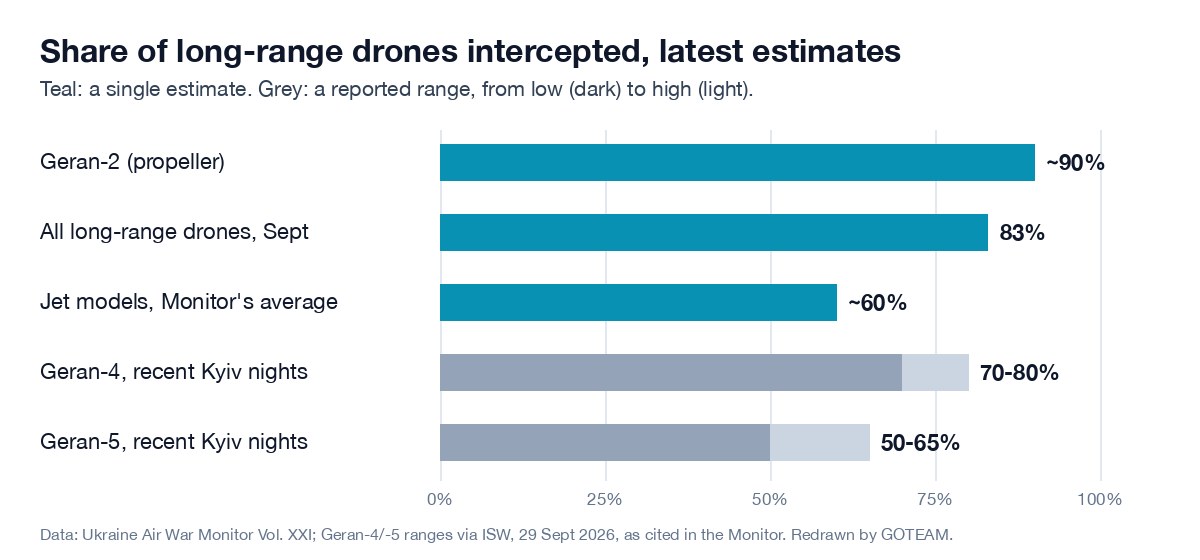
- Jet-powered Gerans rose from about 350 in June to about 3,900 in September. The Monitor estimates about 60% are intercepted, against about 90% for the Geran-2.
- Newer Gerans navigate by matching camera images to the terrain, and the Geran Seeker locks onto its target by itself from 5 to 10 km in good visibility.
- Ukraine's layered answer, from interceptor drones to F-16 cannons, needs an accurate cue for every layer.
- A European Defence Agency report lists air defence and early warning among Europe's weakest layers, the ones under most strain in Ukraine.
The Ukraine Air War Monitor is a monthly analysis by Kyiv Dialogue with data analyst Marcus Welsch and the Konrad Adenauer Foundation. Its database records more than 128,900 Russian attacks on Ukrainian cities and civilian infrastructure since September 2022. Volume XXI, dated 6 October 2026, covers September (Monitor Vol. XXI). Figures are the Monitor's, or those of the sources it cites.
A fast change in the drone mix
September's change was the mix, not the volume. Russia launched 6,322 long-range drone attacks on civilian targets, up from 4,903 in August but below May's record of 7,503. By the Monitor's calculation, about 3,900 were jet-powered Gerans, up from 2,800 in August, 1,500 in July and 350 in June (Armyinform).
Turbojet Gerans fly faster and higher than the piston-engined Geran-2, which autocannons and other barrel weapons could still shoot down. A new variant seen in September, the Geran-5-K5, has a repositioned engine that cuts drag for even higher speed (Militarnyi).
The average interception rate for all long-range drones held at 83%, as in August. The Monitor puts the Geran-2 at about 90% and assumes about 60% for the jet models, though estimates vary: reports from recent attacks on Kyiv suggest 70 to 80% for the Geran-4 and 50 to 65% for the Geran-5 (ISW). With far more jet drones in the mix, the Monitor reads the steady 83% as Ukrainian air defence adapting. Still, a record 1,090 drones were not intercepted, up from 832 in August, and targets hit rose to 581.
This is an innovation cycle. After Ukraine intercepted 91.5% of drones in May, Russia shifted to the new Gerans; when the Geran-4 became easier to intercept, it used more Geran-5s. If Ukraine counters the jet models too, the Monitor expects Russia to turn more to ballistic missiles.
Guidance without satellites or a link
The drones are also changing how they find their targets.
- Image-matching navigation. The Geran-5-K5 matches terrain features with an electro-optical system, correcting its route without satellite navigation (Militarnyi). Ukraine's military intelligence, HUR, reports a similar system, "Susanin", on the Geran-4 (HUR).
- Autonomous lock-on. Drone expert Serhii "Flash" Beskrestnov says target recognition and tracking are established, while automatic target selection was still in early testing in spring 2026 (Ukrainska Pravda). Autonomous terminal guidance is already fielded in the Geran Seeker: a pilot assigns the target, and the drone steers itself onto it from five to ten kilometres in good visibility (Beskrestnov; Beskrestnov). The Australian Army Research Centre finds AI entering guidance, but human oversight still central to target selection and engagement (AARC).
- Mesh relays for reach. Repeater drones in a mesh network extend how far Russian pilots can control their drones; since these networks began operating from Belarus, attacks have reached Volyn, Zhytomyr and Khmelnytskyi (Ukrinform). In the 4 September attack on SBU headquarters in Kyiv, a remotely piloted Geran was steered in through an internet-connected mesh repeater an agent had switched on within 5 km of the target (Kyiv Independent).
Relays add detectable radio traffic during cruise, but over the final kilometres, the Monitor says, drones increasingly find their target on their own, "without a jamming-prone radio link." In our view, jamming and RF direction-finding lose the last, most important minutes of the flight, and satellite-navigation jamming matters less once a drone navigates by camera.
Layered defence depends on its cue
Ukraine's winter plan combines propeller- and jet-powered interceptor drones, low-cost surface-to-air missiles, manned and automated gun turrets, and MANPADS. The Monitor calls this technically right; the open question is whether production can grow fast enough.
- Interceptor drones. Several types that can catch jet drones are in testing, with kills confirmed above 400 km/h. Keeping up with short innovation cycles and scaling production are harder, and Ukraine depends on foreign help for jet engines.
- F-16s. They shoot down 50 to 60% of Russia's jet drones (Zelenskyy), but more than half of Ukraine's F-16s are grounded awaiting maintenance (WSJ). Air-to-air missiles are expensive and increasingly scarce, so the 20 mm cannon, with cheap, widely available ammunition, is for now the best option (Kyiv Independent; Bloomberg). Subsonic jets such as the L-39 could also help (ZDF).
In our view, these layers are cheap because they work at short range, and short range leaves little time: at 400 km/h a drone covers a kilometre in nine seconds. Each turret, MANPADS team, interceptor or cannon pass needs the target's position, height, speed and heading early and accurately enough to engage without wasting a shot. The more layers, the more depends on that cueing picture.
That picture can be fragile. Ukrainian Railways decides its own train evacuations using direct access to airspace surveillance data; when a drone disappears from radar, it coordinates with the Air Force and evacuates when in doubt (FAZ).
Radar remains the backbone. As more drones go silent in the final phase, passive sensors that emit nothing add a layer that neither depends on the drone's radio link nor reveals the defender's position. Thermal imaging is one, and a turbojet engine is a strong heat source.
Europe's gap sits in the same layer
Europe's largest capability gaps, the Monitor notes, are the areas proving most critical in Ukraine. A confidential European Defence Agency interim report, reported by FAZ, names them as air defence, strategic reconnaissance and early warning, ammunition, and emerging technologies, and finds EU states invested only 13% of defence spending jointly in 2025, against a 40% target for 2030 (FAZ).
The Monitor calls the jet-drone shift a warning to Europe to match Russia's innovation cycles, and the pressure is already direct. On 10 September, Polish airspace was violated 19 times (GOV.pl); drones also overflew Moldova and Romania and violated Lithuania's airspace. Poland changed its pilots' rules of engagement so they can react faster (Gazeta Wyborcza). On 13 September, a drone hit the locomotive of the Kyiv–Warsaw train two kilometres from the Polish border.
What we take away
- Higher speed is the baseline. Defences tuned for the Geran-2 have less time to engage.
- Assume the final approach is silent. Detection that waits for the drone to transmit will increasingly miss the end of the flight.
- Cheap effectors need precise cues. Every layer needs a timely, accurate track, so sensing has to scale with the effectors.
- Adapt at Russia's pace. Russia counters within months. Europe will meet the same drones, and the EDA already lists those layers among its largest gaps.
Bottom line: the threat is getting faster and quieter in the final approach while the defence splits into many cheap, short-range layers. That makes the sensing and cueing layer that ties them together more important, not less.
- Kyiv Dialogue / European Exchange, "Ukraine Air War Monitor, Vol. XXI," data and analysis by Marcus Welsch, 6 October 2026 — https://www.kyiv-dialogue.org/en/news/newsreader/ukraine-air-war-monitor-vol-xxi.html
- Armyinform, 14 September 2026 — https://armyinform.com.ua/2026/09/14/%c2%abdrony-jdut-odyn-za-odnym%c2%bb-u-povitryanyh-sylah-rozpovily-pro-zminu-taktyky-rosijskyh-atak/
- Institute for the Study of War, "Russian Offensive Campaign Assessment, September 29, 2026" — https://understandingwar.org/research/russia-ukraine/russian-offensive-campaign-assessment-september-29-2026/
- Militarnyi, "Russian forces begin using new Geran-5 version with autonomous optical navigation," 27 September 2026 — https://militarnyi.com/en/news/russian-forces-begin-using-new-geran-5-version-with-autonomous-optical-navigation/
- Defence Intelligence of Ukraine (HUR), Telegram, 5 October 2026 — https://t.me/DIUkraine/9644
- Ukrainska Pravda, 24 June 2026 — https://www.pravda.com.ua/eng/news/2026/06/24/8040873/
- Serhii Beskrestnov, Telegram, 30 June 2026 — https://t.me/serhii_flash/7527
- Serhii Beskrestnov, Telegram, 20 September 2026 — https://t.me/serhii_flash/7763
- Australian Army Research Centre, "Drones in modern warfare 2024–2026," 3 August 2026 — https://researchcentre.army.gov.au/library/occasional-papers/drones-modern-warfare-2024-2026
- Ukrinform, 2 October 2026 — https://www.ukrinform.de/rubric-ato/4170536-grenzschutz-belarus-stimmt-einschaltung-von-relaisanlagen-wahrend-drohnenangriffe-auf-ukraine-mit-russland-ab.html
- Kyiv Independent, 5 September 2026 — https://kyivindependent.com/breaking-russian-drone-hits-kyivs-center/
- Volodymyr Zelenskyy, X, 2 October 2026 — https://x.com/ZelenskyyUa/status/2105992007130689939
- Wall Street Journal, 29 September 2026 — https://www.wsj.com/opinion/ukraine-f-16-maintenance-delays-russia-sabena-engineering-85ca626a
- Kyiv Independent, "Ukrainian pilots forced to take risks as Russian jet-powered drones strain missile supplies," 10 September 2026 — https://kyivindependent.com/ukrainian-pilots-forced-to-take-risks-as-russian-jet-powered-drones-strain-missile-supplies/
- Bloomberg, "Ukraine seeks shells for F-16s to shoot down jet-powered drones," 30 September 2026 — https://www.bloomberg.com/news/articles/2026-09-30/ukraine-seeks-shells-for-f-16s-to-shoot-down-jet-powered-drones
- ZDF heute, 1 October 2026 — https://www.zdfheute.de/video/zdfheute-live/gressel-ukraine-operation-vivaldi-roboter-video-100.html
- Frankfurter Allgemeine Zeitung, 27 September 2026 — https://www.faz.net/aktuell/politik/ukraine/ukrainischer-bahnchef-perzowskyj-die-russen-wollen-uns-von-der-welt-abschneiden-201265379.html
- Government of Poland, statement by Deputy Prime Minister Sikorski on the violation of Polish airspace, 10 September 2026 — https://www.gov.pl/web/denmark/statement-by-deputy-prime-minister-sikorski-on-the-violation-of-polish-airspace
- Gazeta Wyborcza, 24 September 2026 — https://wyborcza.pl/7,75398,33041533,sekundy-zamiast-minut-polska-radykalnie-zaostrza-procedury.html
- Frankfurter Allgemeine Zeitung, on the European Defence Agency interim report, 29 September 2026 — https://www.faz.net/aktuell/politik/ausland/die-eu-staaten-geben-viel-fuer-verteidigung-aus-schliessen-aber-kaum-luecken-accg-201272102.html
- IISS, "Ukraine: the war Europe is not fighting," Survival Online, 25 September 2026 — https://www.iiss.org/online-analysis/survival-online/2026/09/ukraine-the-war-europe-is-not-fighting/
Independent commentary by GOTEAM. Not affiliated with or endorsed by Kyiv Dialogue, the European Exchange, the Konrad Adenauer Foundation or any other organisation named above. Figures are as published in the Monitor or the sources it cites and have not been independently verified. Charts are redrawn by GOTEAM from figures published in the Monitor.
Working the counter-drone problem?
We build passive thermal detection for sites that need a track without waiting for the drone to transmit.