In short
- Mass and speed: cheap drones in huge numbers drain expensive interceptors, and jet drones leave less time to engage.
- Autonomy at the end: recognition and terminal guidance are fielded; machine target selection is not, at scale.
- Links that evade jamming: fibre-optic FPVs have no radio link and mesh relays extend range; an engine-off terminal glide is a scenario, not an observed trend.
- Cheap, layered defence: interceptor drones and guns carry the load while lasers and microwave weapons mature; layers need one shared picture.
- The fight comes home: Europe, the Gulf and US bases face the same drones and the same cost problem.
This post looks at trends, not products, mostly from 2025 and 2026 sources. We flag older sources and unverified claims from one side of a war.
1. Mass beats price
Cheap drones in huge numbers drain expensive interceptors. Dmytro Zhmailo of the Ukrainian Security and Cooperation Centre counts about 2,800 Shahed-type launches against Ukraine in all of 2023 and more than 41,500 in the first seven months of 2026, with Russia's Alabuga plant making about 5,800 a month by 2026 (Defence24). In September 2026 the Ukraine Air War Monitor recorded 6,322 long-range drone attacks on civilian targets and 1,090 drones not intercepted, the most of the war so far (Monitor Vol. XXI).
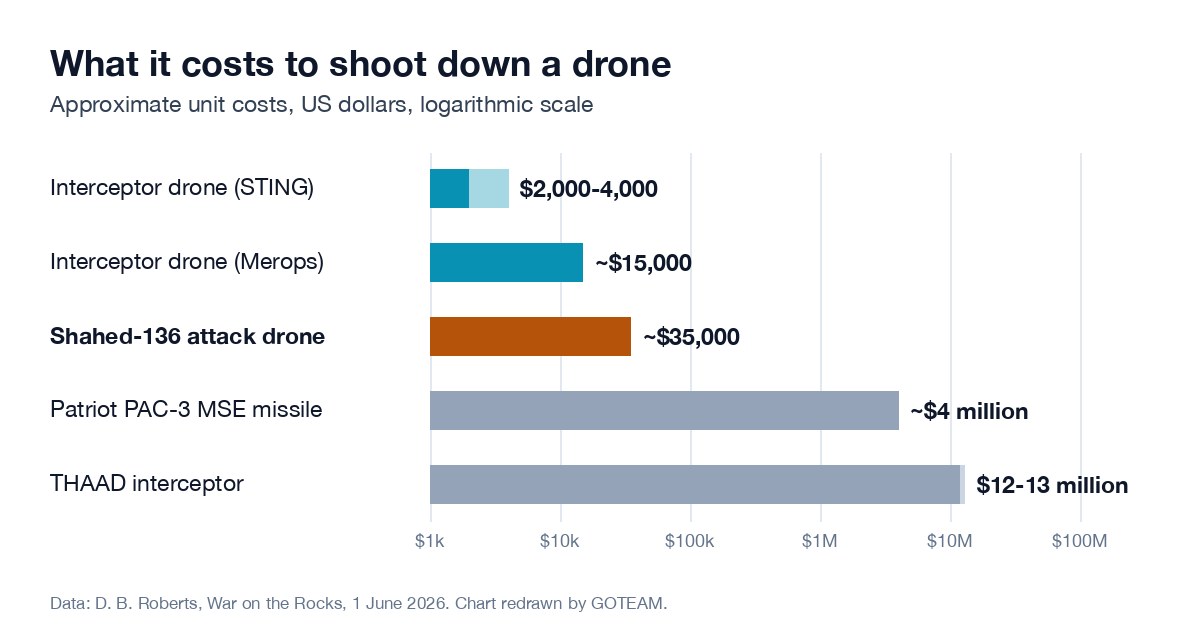
David B. Roberts of King's College London puts a Shahed-136 at about $35,000 and a Patriot PAC-3 MSE at about $4 million. He estimates more than 1,000 Patriots were fired in the first ten days of the 2026 Iran war, against regional stocks of roughly 1,800 to 2,300 and annual PAC-3 production of about 600 (War on the Rocks).
Coordinated swarms are still small. Ukraine's Swarmer software, reported in September 2025, let groups of three to eight drones divide up a strike after a human ordered it; tests reached 25 drones, with 100 planned (Ukrainska Pravda). Our reading: large autonomous swarms have not been seen in combat, and raw numbers do most of the damage.
2. Jet drones compress the timeline
Faster, higher and steeper attacks leave less time to detect and engage. The Monitor counts about 350 jet-powered Gerans in June 2026 and about 3,900 in September, with interception rates of about 90% for the propeller Geran-2 and about 60% for the jets (Monitor Vol. XXI). Ukraine's defence intelligence gives the Geran-5 a cruise speed of 450 to 600 km/h (Militarnyi).
Zhmailo puts the success rate of Ukraine's interceptor drones against jets above 400 km/h at only about 10% of launches (Defence24). In May 2025 Ukraine's air force described Shaheds cruising above 2 km, then diving steeply to stay out of machine-gun range (Business Insider via Yahoo). The jet drone is closer to a cheap cruise missile than to a slow, low, loud target.
3. Autonomy takes over the last kilometres
Recognition and terminal guidance are fielded; machine target selection is not, at scale. Ukrainian radio specialist Serhii "Flash" Beskrestnov separates three capabilities (Ukrainska Pravda):
- Target recognition and tracking: neural networks recognise an object and hold a camera on it. Already in use.
- Terminal guidance: the operator designates the target and the drone flies the last stretch. Both sides do this; the Monitor reports Russia's Geran Seeker locks on from five to ten kilometres in good visibility (Monitor Vol. XXI).
- Target selection: the machine decides what to attack. In June 2026 Beskrestnov said this was in early combat testing on both sides.
One reported Geran-5 variant corrects its route by matching camera images of the ground instead of using satellites, though Ukraine has not officially confirmed it (Militarnyi). Defence is automating too: Zhmailo writes that by June 2026 about 95% of Ukraine's interception process was automated, with the operator picking the target and authorising the attack (Defence24). An August 2026 Australian Army Research Centre study describes autonomous targeting aids and navigation as responses to jamming (Defence Connect), with human oversight still central to choosing targets, per the Monitor's summary.
4. Control links leave or hide in the spectrum
Control links are moving out of reach of jamming, by cable or by relay. Fibre-optic FPVs, first used at scale by Russia in August 2024, now reach more than 30 km (Russian) and about 40 km (one Ukrainian model). With no radio link there is nothing to jam and no control signal to detect. The Atlantic Council lists shotguns, barriers, radar tripwires, acoustic sensors and experimental AI-assisted detection as countermeasures, with no single answer (Atlantic Council).
Mesh relays extend the radio link instead. In April 2026 Beskrestnov described Shahed and Gerbera drones relaying control signals in an airborne chain of up to 220 km if the relay flies high enough, with at most two or three relays because each adds delay; jamming satellite navigation does not stop a drone flown by hand over this link (Ukrainska Pravda). The same modems have been seen on Molniya, Gerbera and Kub drones (The Defense Post). The Monitor reports a Geran guided onto the SBU headquarters in Kyiv through an internet-connected repeater an agent had switched on nearby.
Relays still transmit and can be found and attacked. Fibre and terminal guidance point to a drone reachable by radio for most of its flight but silent at the end.
5. A silent final approach (scenario)
An engine-off glide onto the target is a plausible next step, but we found no credible report of Geran, Shahed or FPV drones doing this in combat. Some designs advertise it: an Indian munition in development cuts its engine for a silent terminal glide (IDRW), and a Greek engineless munition is promoted for low acoustic and electromagnetic signatures (Greek City Times). Both are design claims, not combat evidence.
A glide would remove the engine sound, the exhaust plume and, without a link, radio emissions in the final seconds. Ukraine's network of nearly 10,000 low-cost microphones, which passes tracks to mobile gun teams, shows how much defences rely on sound (2024 reporting, Defense One).
Our reasoning, not a sourced finding (we found no published cooling data): a just-stopped engine and airframe should stay warmer than clear sky for a while, the glide path stays visible to radar and optical sensors, and the lost energy narrows the approach angles.
6. Cheap effectors replace expensive missiles
Interceptor drones and guns will carry most of the near-term load while lasers and microwave weapons mature. Zhmailo estimates Ukraine's interceptor drones at $1,000 to $2,000 each and writes that they downed more than 33,000 hostile drones in March 2026 (Defence24). The Monitor reports test kills above 400 km/h and names scaling production as the main challenge.
- Guns and helicopters. Roberts names Gepard-derived guns among the cheapest effective options, at about €4,000 per engagement; the UAE has used helicopters against Shaheds (War on the Rocks).
- Electronic warfare. Roberts cites about 40% of drones diverted in large Ukrainian attacks, while Russia hardens its drones against jamming.
- Fighter cannons. The Monitor cites Ukraine's president as saying F-16s down 50 to 60% of Russian jet drones.
- Lasers. Israel's Iron Beam, delivered in December 2025, was reported in August 2026 as not yet fully operational (The Defense Post).
- High-power microwave. The US Army awarded up to $49 million for a mobile microwave system against small drones, with field trials in 2027; its value against swarms is the maker's claim (The Defense Post).
7. Defence becomes layered and sensor-fused
No single effector covers every threat, and layers only work if they share one picture. The Monitor describes Ukraine's winter plan of interceptor drones, low-cost surface-to-air missiles, gun turrets and portable air-defence missiles, and the Australian study argues for a layered detect-track-defeat network (Defence Connect). Roberts notes that losing early-warning radars in the Gulf meant firing more interceptors at each threat.
The UK's open SAPIENT standard lets sensors and decision modules from different vendors share tracks. At a 2021 NATO exercise it linked 17 sensor modules to 7 decision-making modules, and the UK Ministry of Defence adopted it as its counter-drone standard (GOV.UK). NATO said in 2023 it would adopt SAPIENT, with ratification starting in 2024 (Janes); we could not confirm ratification is complete.
8. The fight comes home
The same drones and cost problem now reach Europe, the Gulf and US bases:
- Europe. At least 19 Russian drones entered Polish airspace on 10 September 2025; NATO shot down three and launched Operation Eastern Sentry (The Aviationist). On 22 to 28 September 2025 drones disrupted Danish airports, including Copenhagen, and two air bases; Russian involvement was suspected but not confirmed (European Security & Defence). The EU's drone defence initiative aims for full capability by the end of 2027, but in March 2026 its sensors and command arrangements were undecided (European Security & Defence).
- The Middle East. Iran claimed more than 2,000 drones and 500 ballistic missiles early in the 2026 war, which Roberts treats as unverified. Gulf officials say stocks are adequate, but how fast interceptors are being used up is unknown (Semafor).
- Home territory. In May 2026 the US joint counter-drone task force picked five bases for a pilot, two testing directed-energy weapons; earlier laser use near the southern border had closed El Paso airspace twice in one month (Defense News).
What stays uncertain
- After jet drones: the Monitor expects Russia to turn more to ballistic missiles if Ukraine learns to stop jets.
- Autonomy and swarms: target selection is not fielded at scale, the image-matching Geran is unconfirmed, and large swarms and silent glides are unseen.
- Directed energy: lasers and microwave systems are still in delivery and trials, so their cost per kill in bad weather is unknown.
- The numbers: most interception rates and kill counts come from one side of a war, and Gulf stockpile figures are disputed.
What this means for counter-UAS
- Detection cannot rely on radio or engine noise. Fibre control, terminal guidance and possibly engine-off glides remove both in the final seconds; sensors must see the airframe itself.
- Persistent coverage, not only cueing. Against a jet drone or steep dive there may be no time to point a narrow sensor after an alert.
- Open handoff standards. Interfaces such as SAPIENT move a track from the sensor that found it to the effector that engages it without custom integration.
- Adapt at the opponent's pace. The Australian study's verdict was that "No technical advantage proved enduring without continuous modification." Sensing, classification and procedures need updating on that cycle.
Bottom line: more drones, faster drones and drones that fall quiet at the end. The cheap effectors exist; the harder problem is seeing every target early, without relying on it to give itself away.
- Kyiv Dialogue / European Exchange, "Ukraine Air War Monitor, Vol. XXI," data and analysis by Marcus Welsch, dated 6 October 2026 (web page posted 12 October 2026) — https://www.kyiv-dialogue.org/en/news/newsreader/ukraine-air-war-monitor-vol-xxi.html
- Dmytro Zhmailo, "Race for the skies: the evolution of interceptor drones and Russia's adaptation," Defence24, 7 September 2026 — https://defence24.com/industry/race-for-the-skies-the-evolution-of-interceptor-drones-and-russias-adaptation
- David B. Roberts, "Fences Not F-35s: Drone Attacks and the Illogic of Gulf Procurement," War on the Rocks, 1 June 2026 — https://warontherocks.com/fences-not-f-35s-drone-attacks-and-the-illogic-of-gulf-procurement/
- Matthew Martin, "Gulf officials insist weapons systems are well stocked amid questions," Semafor, 3 March 2026 — https://www.semafor.com/article/03/03/2026/gulf-officials-insist-weapons-systems-are-well-stocked-amid-questions
- Militarnyi, "Russian forces begin using new Geran-5 version with autonomous optical navigation," 27 September 2026 — https://militarnyi.com/en/news/russian-forces-begin-using-new-geran-5-version-with-autonomous-optical-navigation/
- Matthew Loh, "Russia has a new drone tactic: dive-bombing with Iranian-designed Shaheds from on high," Business Insider (via Yahoo News), 28 May 2025 — https://www.yahoo.com/news/russia-drone-tactic-dive-bombing-060045080.html
- Ukrainska Pravda, interview with Serhii Beskrestnov on drone autonomy, 24 June 2026 — https://www.pravda.com.ua/eng/news/2026/06/24/8040873/
- Robert Dougherty, "Australian adaptability: Ukraine's drone war is changing warfare," Defence Connect, 6 August 2026, reporting O. Molloy, "Drones in modern warfare (2024–2026)," Australian Army Research Centre, 3 August 2026 — https://www.defenceconnect.com.au/joint-capabilities/18659-australian-adaptability-ukraine-s-drone-war-is-changing-warfare-can-the-adf-adapt-fast-enough-to-keep-up
- Vlad Sutea, "Fiber optics drones have emerged as critical kit for both Russia and Ukraine," Atlantic Council UkraineAlert, 24 February 2026 — https://www.atlanticcouncil.org/blogs/ukrainealert/fiber-optics-drones-have-emerged-as-critical-kit-for-both-russia-and-ukraine/
- Iryna Levytska, "Shahed-type drones fly deeper into Ukrainian rear using relay drones," Ukrainska Pravda, 28 April 2026 — https://www.pravda.com.ua/eng/news/2026/04/28/8032207/
- Rojoef Manuel, "Russia fits Shahed mesh modems on Molniya drones," The Defense Post, 24 February 2026 — https://thedefensepost.com/2026/02/24/russia-molniya-shahed-modems/
- IDRW, "ADSL developing 30 km loitering munition system," 8 April 2026 — https://idrw.org/adsl-developing-30-km-loitering-munition-system-to-boost-indian-infantrys-beyond-line-of-sight-strike-capability/
- Greek City Times, "Midros MFK120-1X loitering munition," 7 September 2025 — https://greekcitytimes.com/2025/09/07/midros-mfk120-1x-loitering-munition/
- Audrey Decker, "Ukraine's cheap sensors are helping troops fight waves of Russian drones," Defense One, 20 July 2024 — https://www.defenseone.com/defense-systems/2024/07/ukraines-cheap-sensors-are-helping-troops-fight-waves-russian-drones/398204/
- Ukrainska Pravda, citing The Wall Street Journal, "Ukrainian forces using drone swarms that autonomously locate and strike targets," 3 September 2025 — https://www.pravda.com.ua/eng/news/2025/09/3/7529154/
- The Defense Post, "Israel's Iron Beam still not fully operational eight months after delivery," 11 August 2026 — https://thedefensepost.com/2026/08/11/israel-iron-beam-operational-delay/
- Giulia Bernacchi, "US Army to test ThinKom's mobile microwave counter-drone system," The Defense Post, 21 August 2026 — https://thedefensepost.com/2026/08/21/us-army-thinkoms-counter-drone/
- GOV.UK (Dstl), "NATO trials Dstl standard for counter-drone systems," 5 January 2022 — https://www.gov.uk/government/news/nato-trials-dstl-standard-for-counter-drone-systems
- Olivia Savage, "NATO to adopt SAPIENT as C-UAS standard," Janes, 25 September 2023 — https://www.janes.com/defence-news/defence/latest/nato-to-adopt-sapient-as-c-uas-standard
- Stefano D'Urso, "NATO launches Operation Eastern Sentry," The Aviationist, 13 September 2025 — https://theaviationist.com/2025/09/13/nato-launches-operation-eastern-sentry/
- Peter Felstead, "RAF C-UAS unit deployed to Denmark," European Security & Defence, 2 October 2025 — https://euro-sd.com/2025/10/major-news/47065/raf-c-uas-unit-to-denmark/
- Thomas Withington, "Europe's Drone Wall – Ready, EDDI, Go!," European Security & Defence, 13 March 2026 — https://euro-sd.com/2026/03/articles/exclusive/49854/europes-drone-wall-ready-eddi-go/
- Cristina Stassis, "5 US bases selected for anti-drone pilot program," Defense News, 11 May 2026 — https://www.defensenews.com/industry/techwatch/2026/05/11/5-us-bases-selected-for-anti-drone-pilot-program/
Independent commentary by GOTEAM. Not affiliated with or endorsed by any organisation named above. Figures are as published in the sources listed and have not been independently verified; many come from parties to the conflicts described. The cost chart is redrawn by GOTEAM from figures published in War on the Rocks.
Working the counter-drone problem?
We build passive thermal detection for sites that need a track without waiting for the drone to transmit.