In short
- SCD's Mini Blackbird 1280 is a cooled mid-wave infrared (MWIR) core, 1280 × 1024 at 10 µm, NETD under 25 mK. Teledyne FLIR's Boson 640 is an uncooled long-wave infrared (LWIR) core, 640 × 512 at 12 µm, 20–60 mK.
- At equal pixels per degree, a Blackbird covers about 3.6 times the sky per camera, so a 360° ring takes 7 cameras instead of 12. Behind a long lens it puts many times more pixels on a small drone than any wide camera can.
- The Boson draws about a watt, weighs tens of grams with a lens, has no cryocooler, and has a published US export classification and list price. SCD publishes none of those for the Blackbird.
Why compare these two
The two cores sit at opposite ends of the counter-drone design space. The Boson 640 is a small, low-power uncooled long-wave core, widely used in staring cameras. SCD (SemiConductor Devices)'s Mini Blackbird 1280 is one of the most compact cooled, high-definition mid-wave cores. Every number comes from the manufacturer's own published material, listed at the end.
The two cores on paper
SCD publishes two variants: HOT XBn, and HFM ("Hot Full Mid-wave", 2024 datasheet) with a wider band and higher frame rate.
| SCD Mini Blackbird 1280 (XBn) | SCD Mini Blackbird 1280 HFM | Teledyne FLIR Boson 640 | |
|---|---|---|---|
| Band | MWIR, 3.6–4.2 µm (1–4.2 µm on request) | MWIR, 3.6–4.9 µm | LWIR, 8–14 µm |
| Detector | Cooled HOT XBn, FPA at 150 K | Cooled HOT HFM, 120 K operating temp. | Uncooled VOx microbolometer |
| Format / pitch | 1280 × 1024 / 10 µm | 1280 × 1024 / 10 µm | 640 × 512 / 12 µm |
| NETD (published) | < 25 mK at 70% well fill (2 Me⁻ capacitor) | 25 mK at 70% well fill | Boson: ≤40 / ≤50 / ≤60 mK (Industrial / Professional / Consumer). Boson+: ≤20 / ≤30 mK (Industrial / Professional) |
| Max frame rate | 90 Hz raw full window; 60 Hz fully processed | 100 Hz raw (Medium Camera Link) | 60 Hz (30 Hz selectable); export "slow" variants below 9 Hz |
| Optics | F/3.4 or F/4 cold stop; lens from integrator | F/4; lens from integrator | Catalogue lenses, e.g. 14 mm f/1.00 (32°) and 55 mm f/1.01 (8°) |
| Power | Cooler < 2.5 W + proximity electronics < 2.5 W (23 °C, 60 Hz); "about 5W" total | 10 W (25 °C steady state) | 500–1,550 mW depending on configuration and temperature |
| Size / weight | 80 mm along the optical axis; < 350 g | 80 mm; < 350 g | 21 × 21 × 11 mm without lens; 39 g and 35 mm long with the 14 mm lens |
| Cooler | Stirling micro-cooler; options K580, SX-020, RM1S | Split linear | None |
| Output | Camera Link, 13-bit | Digital LVDS / Camera Link | CMOS, BT656-like or USB3 video |
| Export classification | Not stated by SCD | Not stated by SCD | NDAA compliant, ITAR free, EAR 6A003.b.4.a (FLIR) |
| Published price | None found | None found | $4,334–$6,450 at a US distributor for the 14 mm radiometric core, by sensitivity grade |
Two cautions. A Mini Blackbird is not a camera: SCD supplies the detector, dewar and cooler, and an integrator adds the lens, enclosure and video pipeline; a Boson ships as a complete core with a lens. And the NETD figures are measured at different f-numbers, F/4 for the Blackbird and f/1.0 for the Boson, so they are not one test.
What each band actually sees
A small quadcopter's heat peaks in the long-wave band: it comes from motors, speed controllers and the battery, and most of the airframe sits near ambient. Wien's law puts the emission peak of a 300 K (27 °C) object at about 9.7 µm, and of a 340 K (67 °C) motor housing at about 8.5 µm: inside the Boson's 8–14 µm band, well outside the Blackbird's 3.6–4.2 µm.
A 300 K surface emits about 147 times more radiance in 8–14 µm than in 3.6–4.2 µm, and about 405 times more photons (about 36 and 89 against the HFM's 3.6–4.9 µm). Mid-wave compensates twice: its radiance changes faster with temperature, about 4% per kelvin at 300 K against about 1.5% for 8–14 µm, and a cooled photon detector is far more sensitive per photon than a microbolometer. Teledyne FLIR's own guidance places uncooled cameras in the long-wave band because that is where ambient-temperature targets emit most of their energy.
In Teledyne FLIR's fog modelling, LWIR penetrated fog better than MWIR in every case studied, about four times the range in Category II fog; MWIR did best in hot summer or tropical conditions and was more affected by pollutants; in rain the two bands performed similarly. Fudala et al. (2019) measured a DJI Phantom 4 and a DJI Inspire in both bands against clear sky, cloud and land. Such results depend on the scene, so neither band wins outright.
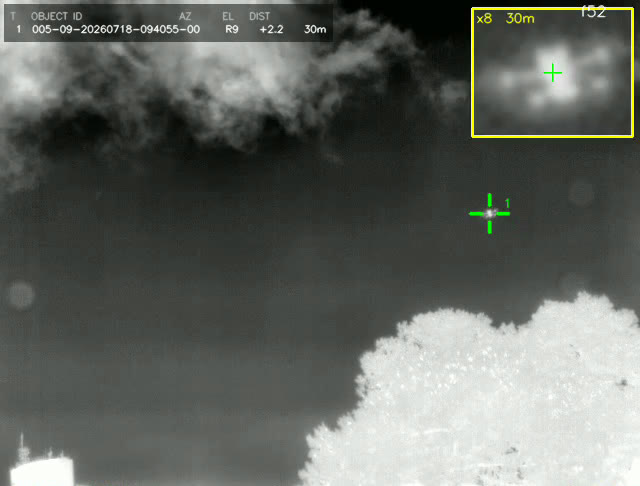
Against a clear sky, a drone in LWIR is a warm object on a cold background; Teledyne FLIR notes that an infrared camera can often detect a moving drone there as a cluster as small as 2 × 2 pixels. Neither band removes warm cloud edges, birds or sun glints; those are an algorithm problem.
Pixels on target: same pixels, fewer cameras
Assumptions: a 0.35 m square target; pixels across the target = size ÷ (range × IFOV), where IFOV = pixel pitch ÷ focal length; Boson lenses are FLIR catalogue lenses. SCD publishes no lens, so every Blackbird focal length below is an assumption, chosen either to match the Boson's field of view or to represent a typical long cooled zoom.
| Configuration | Focal length | HFOV | Px/degree | Px @ 250 m | Px @ 500 m | Px @ 1 km | Px @ 2 km | Cores for 360° |
|---|---|---|---|---|---|---|---|---|
| Boson 640, 14 mm | 14 mm | 30.7°* | 20.9 | 1.63 | 0.82 | 0.41 | 0.20 | 12 |
| Mini Blackbird 1280, same px/degree (assumed lens) | 11.7 mm | 57.5° | 20.9 | 1.63 | 0.82 | 0.41 | 0.20 | 7 |
| Mini Blackbird 1280, matched FOV (assumed lens) | 23.3 mm | 30.7° | 41.7 | 3.27 | 1.63 | 0.82 | 0.41 | 12 |
| Boson 640, 55 mm | 55 mm | 8.0° | 80.1 | 6.42 | 3.21 | 1.60 | 0.80 | 46 |
| Mini Blackbird 1280, matched FOV (assumed lens) | 91.7 mm | 8.0° | 160.2 | 12.83 | 6.42 | 3.21 | 1.60 | 46 |
| Mini Blackbird 1280, 300 mm (assumed lens) | 300 mm | 2.4° | 523.7 | 42.0 | 21.0 | 10.5 | 5.25 | 148 |
*Computed from pitch, array width and focal length. FLIR publishes 32.0° for this lens, about 20 pixels per degree, which changes these counts by about 4%.
Same pixels on the drone, fewer cameras. Behind an 11.7 mm lens, each 10 µm Blackbird pixel subtends the same 0.857 mrad as a 12 µm Boson pixel behind 14 mm, so a 0.35 m drone covers the same pixels on both: about 1.6 at 250 m, 0.8 at 500 m and 0.4 at 1 km. But the Blackbird spreads them over 57.5° × 47.4° against 30.7° × 24.7°, about 3.6 times the sky per camera, so a 360° ring takes 7 (6.3 before rounding up, with no overlap) instead of 12. Figures are for the image centre.
At the same field of view, the Blackbird has twice the linear resolution, and in pure geometry a sub-pixel drone fills four times as much of each pixel. Its published 25 mK NETD, against 20–60 mK across the Boson family, also gives it the lower noise floor. Sensitivity is its first clear win.
There is a catch at wide fields. Diffraction blurs a point into a spot about 2.44 × wavelength × f-number ÷ focal length wide in angle: about 1.7 mrad (two pixels) for the Boson's 14 mm f/1.0 lens at 10 µm, but about 3.3 mrad (nearly four pixels) for a Blackbird at F/4 and 3.9 µm behind 11.7 mm, and 1.6 mrad behind 23 mm. So at equal pixel density the Blackbird's point image is twice as wide, and its lower noise floor must make up for the spread signal; at matched wide fields its extra pixels sample almost the same blur, and the four-fold fill gain shrinks. This simple model leaves out aberrations and turbulence.
The cooled core earns its keep at long focal lengths — its second and bigger win. Teledyne FLIR notes that cooled MWIR can use lenses as slow as f/5.5, allowing focal lengths beyond 1,000 mm at manageable cost, and puts the cost crossover from uncooled LWIR above about 250 mm. An uncooled core needs f/1-class optics, so its aperture grows with focal length. Behind a 300 mm lens the Blackbird resolves a 0.35 m drone at 2 km with about five pixels, while the 14 mm Boson sees a fifth of a pixel. To identify a small drone at long range, this is the right tool.
- SCD USA, "Mini Blackbird 1280" product page — https://scdusa-ir.com/products/mini-blackbird-1280/
- SCD USA, Mini Blackbird SXGA datasheet (HOT XBn), linked from the product page — https://scdusa-ir.com/wp-content/uploads/2023/04/Mini_Blackbird-1280_14-2-18_updated-V2a.pdf
- SCD USA, Mini Blackbird 1280 HFM datasheet V1d — https://scdusa-ir.com/wp-content/uploads/2024/10/Mini_Blackbird-1280_HFM_V1d.pdf
- Teledyne FLIR OEM, "Boson — Uncooled, LWIR OEM Thermal Camera Module" product page (specs, sensitivity grades, Boson+ comparison, model list incl. 20640A032, export statement) — https://oem.flir.com/products/boson/
- FLIR, Boson Thermal Imaging Core Product Datasheet, Doc. 102-2013-40 Rel. 330, Oct 2019 (distributor-hosted copy; Table 1, Tables 10–11) — https://www.elimec.co.il/_Uploads/dbsAttachedFiles/Boson.pdf
- OEM Cameras, Teledyne FLIR Boson 640 × 512 14 mm 32° HFoV radiometric core listing (variant prices) — https://www.oemcameras.com/products/20640a032-htm
- Teledyne FLIR OEM, "Thermal Infrared Sensor Design Considerations for Counter-UAS Defense" — https://oem.flir.com/learn/discover/thermal-infrared-sensor-design-considerations-for-counter-uas-defense/
- Teledyne FLIR, "Can Thermal Imaging See Through Fog and Rain?" — https://www.flir.com/discover/rd-science/can-thermal-imaging-see-through-fog-and-rain/
- N. Fudala et al., "Comparison of midwave versus longwave intensity signatures for infrared search and track of small rotorcraft unmanned aerial vehicles," Optical Engineering 58(4) 043107, 2019 — https://doi.org/10.1117/1.OE.58.4.043107
- NIST CODATA, Wien wavelength displacement law constant — https://physics.nist.gov/cgi-bin/cuu/Value?bwien
Independent commentary by GOTEAM. Not affiliated with or endorsed by SCD or Teledyne FLIR. Specifications are quoted from each manufacturer's published material and have not been independently tested by us. Pixel counts, diffraction spots, blackbody ratios and ring sizes are our own arithmetic, and every Blackbird focal length in them is an assumption, not an SCD product.
Working the counter-drone problem?
We build passive thermal detection for sites that need a track without waiting for the aircraft to transmit.