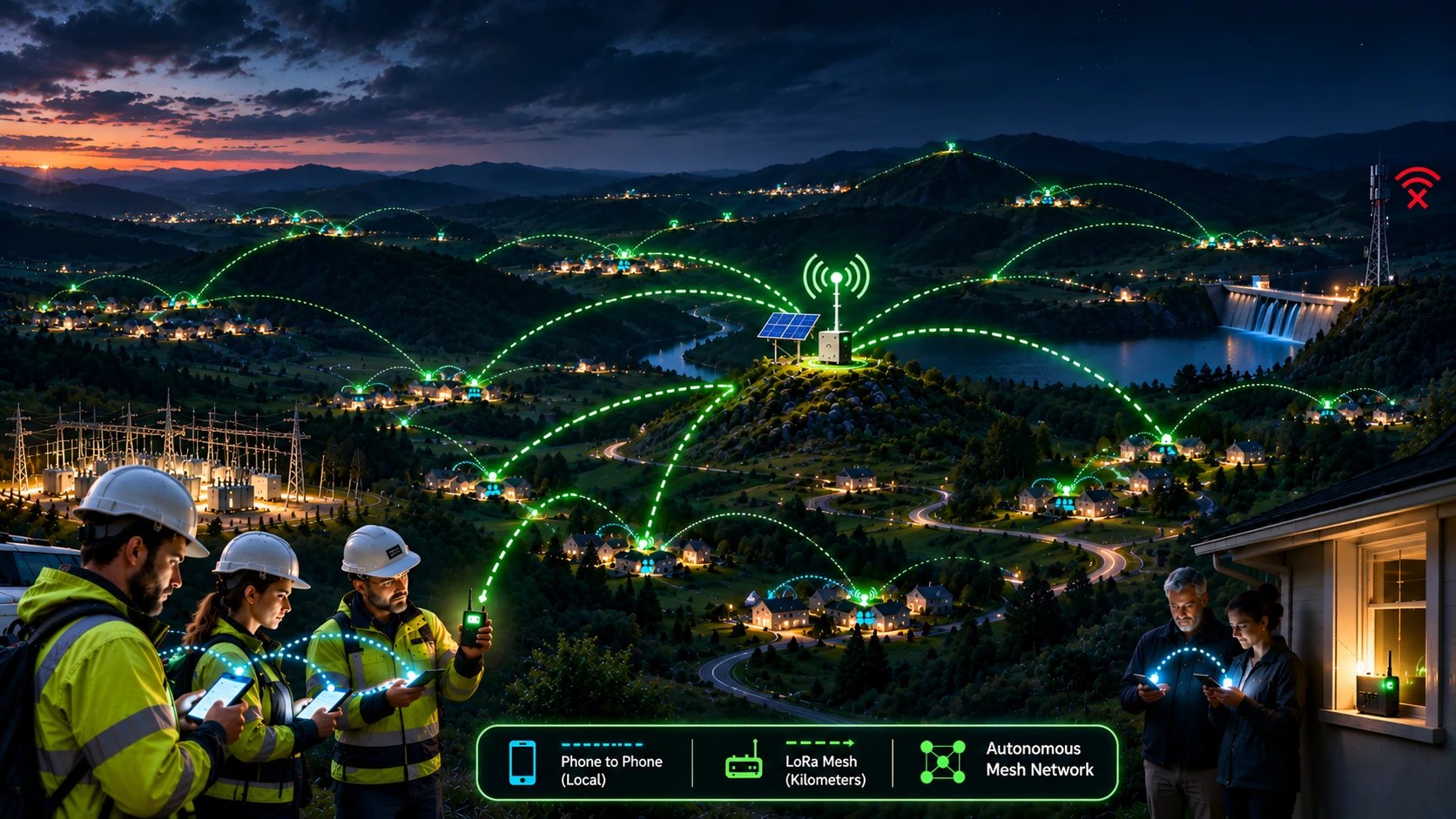
This week a UK lifestyle magazine ran a piece on something that used to live only in emergency planners' documents: the Black Sky event. It describes a widespread failure of essential infrastructure, electricity, water and the mobile phone networks together, usually starting with a major power cut. The article is careful to say that "it is a contingency-planning term, not an official warning that such an event is imminent", and the UK Government calls a total national power outage "very unlikely" (Country Living, via Yahoo).
Its advice is sensible: three days of water, food that needs no cooking, a torch, a power bank, cash, medicines, and a battery or wind-up radio. Health advice in a national outage would be broadcast on BBC Radio 2 and Radio 4, which the Government describes as the most power-resilient way to reach the public. It also suggests keeping a paper list of important numbers and planning how you would contact the people you care about if phones and broadband fail.
The gap in every checklist: talking back
Broadcast radio is one way. A paper list of phone numbers is no use when there is no network to call them on. Mobile masts and broadband cabinets need mains power, and their backup batteries are sized for short cuts, not days. When the power has been off long enough, the phone in your pocket still works, but there is nothing for it to connect to.
That gap hits three groups at once, and they need each other:
- Households. Families who can't find out whether a parent across town is safe, neighbours who can't call for help, and people who depend on medical equipment and can't tell anyone the battery is running out.
- First responders. Police, fire and rescue, ambulance crews, civil defence and the volunteers who join them. Their own radio networks may keep running, but they can't hear the public, and the public can't reach them: the emergency call never connects.
- The crews restoring power, water and the network. Line crews, substation engineers, water operators and their control rooms, coordinating across a region at exactly the moment their own phones, email and chat have gone dark. Critical infrastructure can't plan its recovery on the network it is trying to restore.
One network everyone already carries
O-LINK runs on the Android phones and iPhones people already have, and it doesn't need a mast, a SIM, the internet or anyone's cloud. Every phone running it relays for the others, so every household that installs it makes the network stronger for the responders, and every responder's phone and vehicle makes it stronger for the households. Because everything is encrypted on the phone, a neighbour's phone can safely carry a police message, and a fire engine's radio can carry a family's check-in: neither can read the other's.
When power, phones and the internet fail together, O-LINK falls back through every link that still works, on its own:
For households: "we're OK" when nothing else gets through
- "I'm here" check-ins. One tap tells the people you chose, your family or a neighbour, that you are safe and where you are. They see who has checked in and who hasn't.
- Messages that wait instead of failing. A message to someone out of reach waits on a nearby phone or a base station and is delivered the moment a path appears. Delivery receipts show it arrived.
- SOS to the people you chose. SOS goes ahead of everything else, with your position, to the contacts you picked in advance: family, a neighbour, your street's coordinator.
- Voice, not just text. Push-to-talk in every chat, and calls phone to phone across the street or the building over Wi-Fi, with no network at all.
- Official updates, phone to phone. A council or civil-defence team can run an announcements-only channel for a neighbourhood or village, that residents join in advance with a QR code. Its updates hop from phone to phone, so they reach people the broadcast radio doesn't, and nobody can post into it but the officials.
For first responders: the public, and each other, in reach
- Hear from the street. A street or neighbourhood coordinator in O-LINK can pass "two elderly residents at number 14 need oxygen" to a responder team over the mesh, when no call to the emergency number would connect.
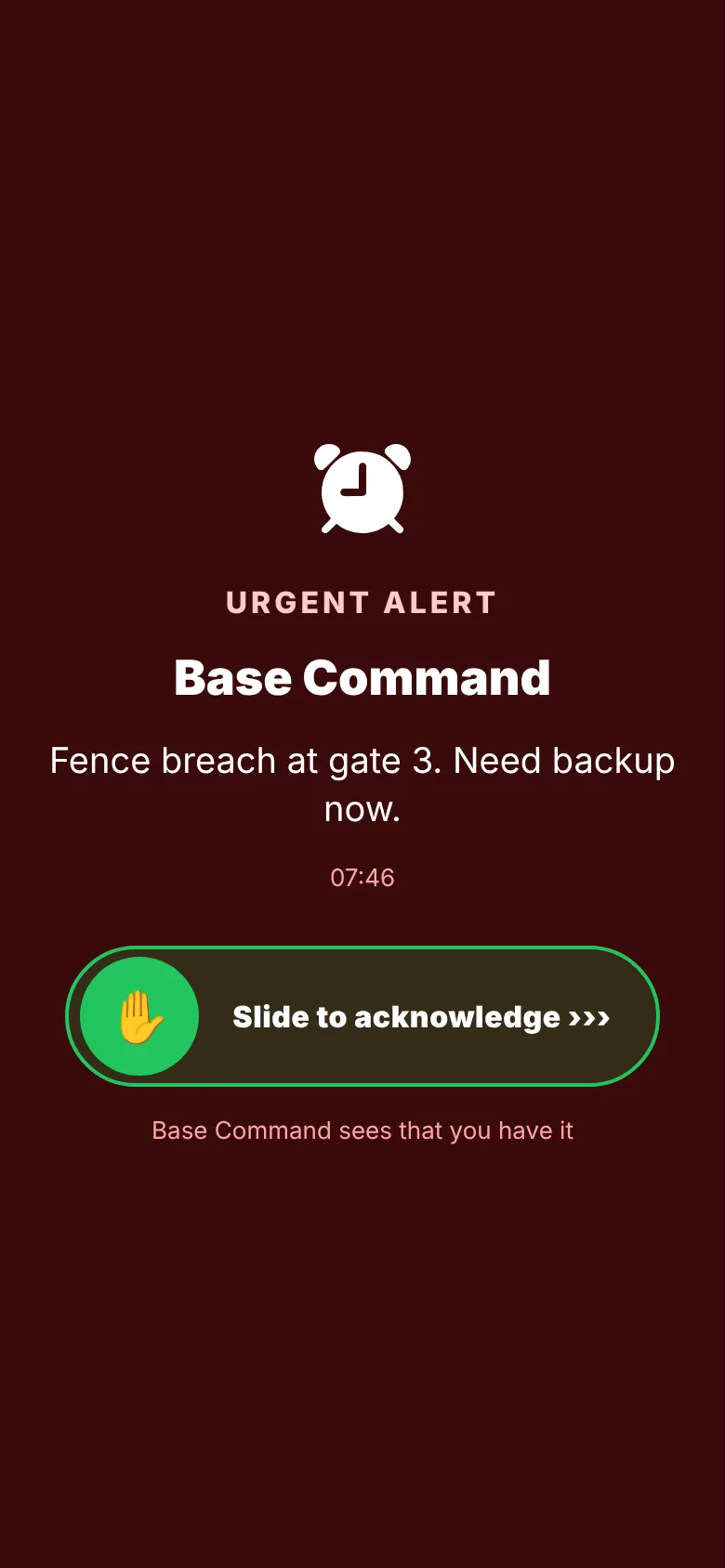
- Emergencies first. SOS, man-down and urgent alerts go ahead of everything else on every link. An urgent alert rings through silent mode until someone takes it.
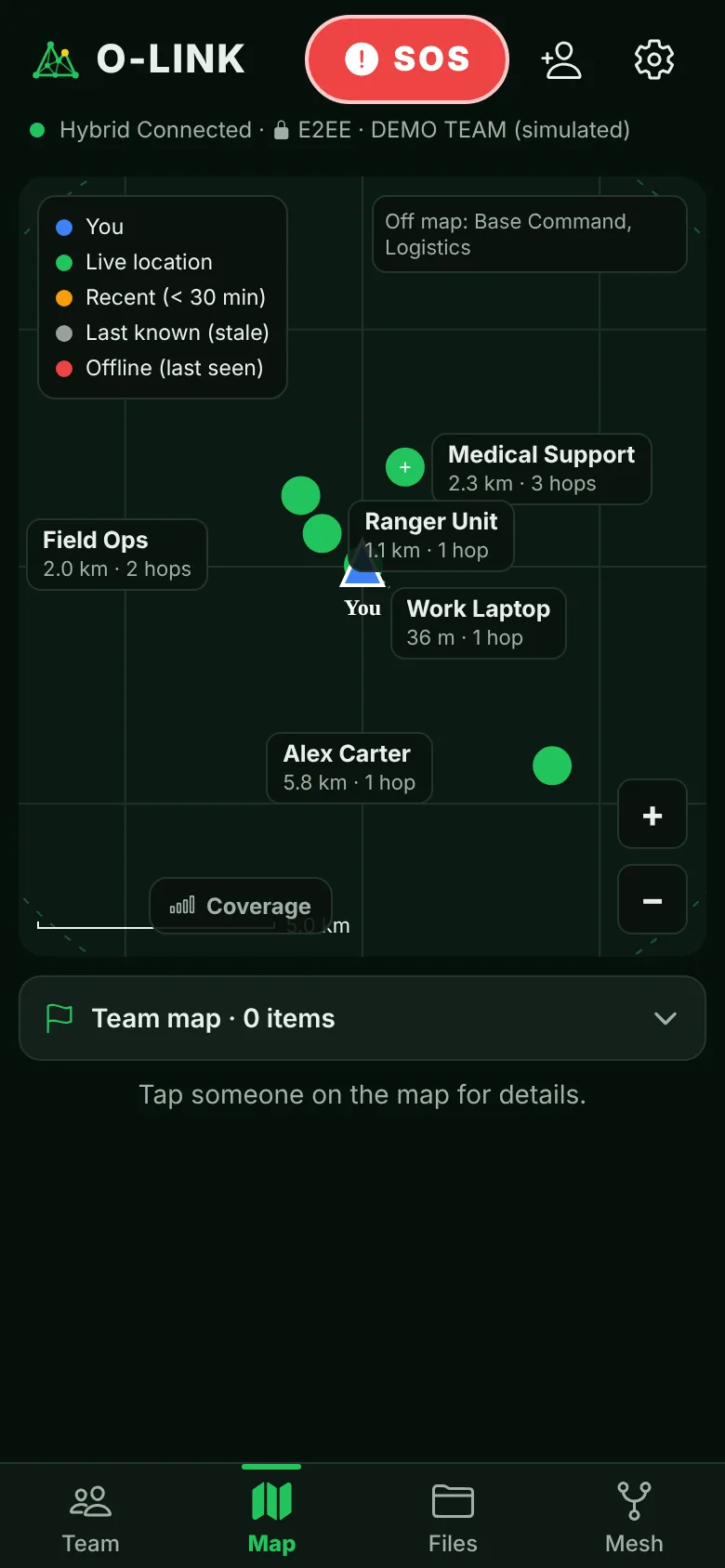
- Where everyone is. A shared map shows each team member's last-known position and the incident's markers, so a control room can send the nearest crew.
- Works with what you have. Positions and SOS go to ATAK and TAK over Cursor-on-Target, so O-LINK can sit alongside the systems a force already uses.
- The control room on a laptop. A phone or base station can serve O-LINK to a laptop's browser over local Wi-Fi, so dispatchers work on a big screen with no internet.
For the crews restoring power and water
- Crew to control room, across the region. Pocket LoRa radios in the vans and base stations at the substations and pumping stations carry messages between sites, kilometres apart.
- Alarms from your own systems. SCADA gateways, UPSs, firewalls and servers send syslog to an O-LINK bridge on the site network, and critical events reach the crews' phones over the mesh, exactly when the email and chat that would normally carry them are down.
- Knowing what is failing. O-LINK shows which links are up, and when several fail together, or a radio channel fills with noise, it flags a possible outage or jamming to your organisation's admin.
- Under your control. Your organisation enrols its phones with a QR code, sets the rules, and can revoke or wipe a lost phone. No vendor's cloud has to be up for your crews to talk.
So does each person need a small LoRa radio?
LoRa is a long-range, low-power radio. A pocket LoRa radio the size of a matchbox can carry short messages several kilometres, further from high ground, runs on its own battery and needs no mast, no SIM and no licence on the licence-free bands. It is the obvious answer to "what still works when nothing else does?" The tempting conclusion is to hand one to everybody.
You don't need to. One radio per group is enough, because the phones already talk to each other:
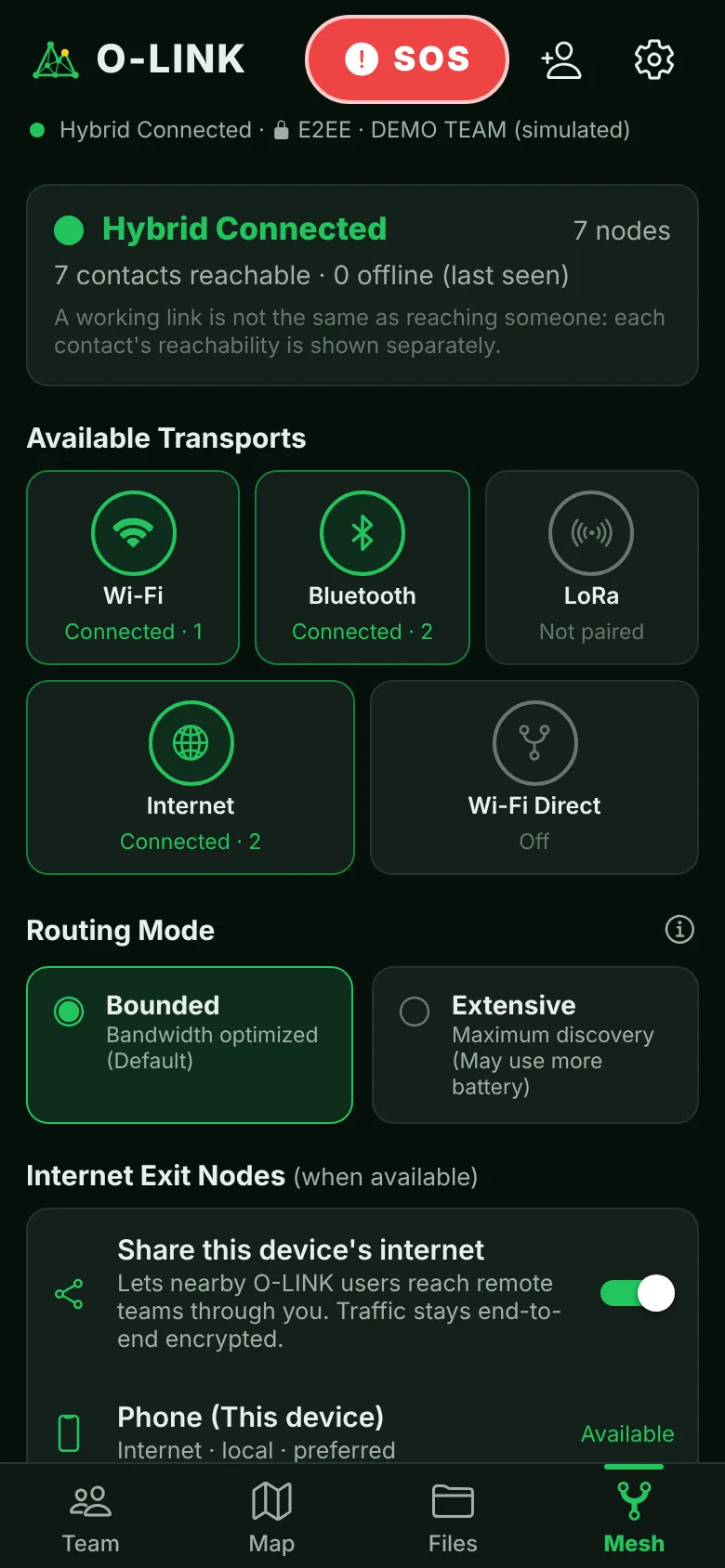
- Phones reach each other directly. Over Bluetooth and Wi-Fi Direct, phones a few rooms or a few houses apart connect without any network at all, tens of metres per hop, and every phone relays for the others. A street, a fire station or a work site becomes one small network.
- One phone in the group carries the radio. It pairs with a pocket LoRa radio over Bluetooth. Messages from everyone nearby hop to that phone and go out over the radio, kilometres to the next group. Nobody else needs to do anything.
- Base stations on high ground join the groups up. An old phone left on a charger and a radio on a rooftop, a hill or a vehicle, ideally with a small solar panel, relays for everyone in range and holds messages for anyone who is out of reach until they come back.
Everything is encrypted on the phone before it leaves, so it doesn't matter whose phone or whose radio relays your message.
Who should carry one
| Who | Radio? | Why |
|---|---|---|
| Each police car, fire engine, ambulance and crew van | One | The crew's phones share it, and the vehicle charges it all day. |
| Police and fire stations, ambulance bases, substations, pumping stations | One, fixed | Mounted high, on a charger: a base station for everyone in range, including the public nearby. |
| Control rooms and the council's emergency centre | One, on the roof | Hears every group in range and keeps the picture together. |
| A street, a village or a block of flats | One or two | Kept by a volunteer coordinator; neighbours' phones reach it over Bluetooth and Wi-Fi Direct. |
| Every household | None needed | Just the phones they already have, with O-LINK on them. A house on its own, out of reach of the neighbours, can add one. |
Two radios in a group are better than one, so the group doesn't depend on a single battery or a single person. Beyond that, extra radios add little: the phones share whichever one is in reach.
Why not just hand out walkie-talkies?
Licence-free walkie-talkies (PMR446 in Europe, FRS in the US) are the usual answer to "what if the phones go down?" They are simple and instant, and for a crew working side by side they are fine. As the way a whole town stays in touch through a Black Sky event, they fall short:
| Walkie-talkies | O-LINK + one LoRa radio per group | |
|---|---|---|
| Who needs a device | Everyone, one each, bought and charged in advance | Nobody new: the phones people already carry, plus one small radio per group |
| Range | Direct only, radio to radio: a few hundred metres in town, a couple of kilometres in the open, no relaying | Every phone relays for the others, and LoRa radios and base stations carry messages kilometres between groups |
| Who can listen | Anyone on the same channel; privacy codes only filter what you hear, they don't encrypt | End-to-end encrypted: only the people it's for can read or hear it |
| Someone out of range or asleep | Missed: if you weren't listening, it's gone | The message waits on a nearby phone or base station and arrives when they're back in reach |
| Busy channels | One person talks at a time on a few shared channels, with every neighbour's radio on them too | Each chat is separate; SOS and urgent alerts go ahead of everything |
| Beyond voice | Voice only | Text, push-to-talk voice, positions on a map, check-ins, SOS and man-down, read receipts |
| Reaching a specific person | Only if they're on your channel, listening, and in range | Message a person, a family or a team directly, like any messaging app |
| Live conversation | Yes, instant, as long as you're in range | Live calls within a group over Wi-Fi; between groups, short push-to-talk voice messages |
Walkie-talkies still have a place: a crew on one site that needs instant voice, or a phone with a flat battery. They work well alongside O-LINK. But they can't carry a family's check-in across town, keep a message for someone who is asleep, or stop the whole street from hearing it.
What gets through, and what doesn't
LoRa is slow, about a kilobit per second, one direction at a time. That is plenty for what matters in a Black Sky event and nowhere near enough for what doesn't:
- Yes: text messages, "I'm here" check-ins, positions on the map, SOS and man-down alerts, and short push-to-talk voice messages. SOS and emergency traffic go ahead of everything else.
- Not over the radio: live voice and video calls. Within a group they still work phone to phone over Wi-Fi; between groups, a call that can't connect becomes a voice message.
- Nothing lost on the way. A message waits on a phone or a base station until a path to its recipient appears, and it is delivered then.
Get ready before the lights go out
For a household, next to the water, the torch and the wind-up radio:
- O-LINK on every phone in the family, with each other, a neighbour and your street's coordinator added as contacts, and SOS set to reach them.
- Your council's or civil defence's announcements channel joined, if it has one.
- Optional: a badge-size LoRa transceiver with Bluetooth, such as the SenseCAP T1000-E. It is the size of a credit card and clips to a bag or a lanyard. It pairs with O-LINK on your phone over Bluetooth and carries your family's messages kilometres, for a house on its own or a street without a coordinator's radio.
- A charged power bank per person, and one test: switch off mobile data and Wi-Fi at home and send each other a message.
For emergency services, councils and utilities:
- O-LINK on every responder's and crew member's phone, enrolled in your organisation with a QR code, tested on a normal day.
- One pocket LoRa transceiver per vehicle, station and site, such as the Heltec MeshPocket: a Meshtastic-compatible radio with its own large battery that pairs with O-LINK over Bluetooth. Get the right band for your region: 868 MHz in Europe, 915 MHz in the US.
- Base stations on the roofs of stations, depots and the emergency centre: an old phone, a radio and a charger, solar where you can.
- An announcements channel for residents, and a volunteer coordinator per street or village who residents can reach.
- A drill: switch off the Wi-Fi and the mobile data for an afternoon and see who can still reach whom.
The question to ask this week
If the power, the phones and the internet went down together tonight, how would a family reach an ambulance, how would your control room reach a crew ten kilometres away, and how would anyone hear what the council has to say? A Black Sky event may be very unlikely. Being unable to talk to each other when it happens is entirely avoidable, and it costs an app and a few small radios, not a new network.
— Baruch
Keep everyone talking when the power and the network don't
For emergency services, councils and utilities: we'll help you set up a pilot, with your phones and LoRa radios where you need the range.