In short
- Purpose-built ground robots almost vanished; the focus has shifted to drones.
- Drones came cheap, easy to fly, day and night. Some autonomous, some fibre-guided and RF-silent.
- Electro-optical counter-UAS splits into cued PTZ trackers and wide-area search, scanning or staring.
- The one signature a drone cannot hide is heat.
The AUSA Annual Meeting and Exposition ran from 12 to 14 October 2026 in Washington, DC, with more than 700 exhibitors (Shephard). We walked it looking at small drones and the systems built to stop them. Every figure below comes from a vendor's display or website and is unverified.
The attack side: cheap, quiet, reusable
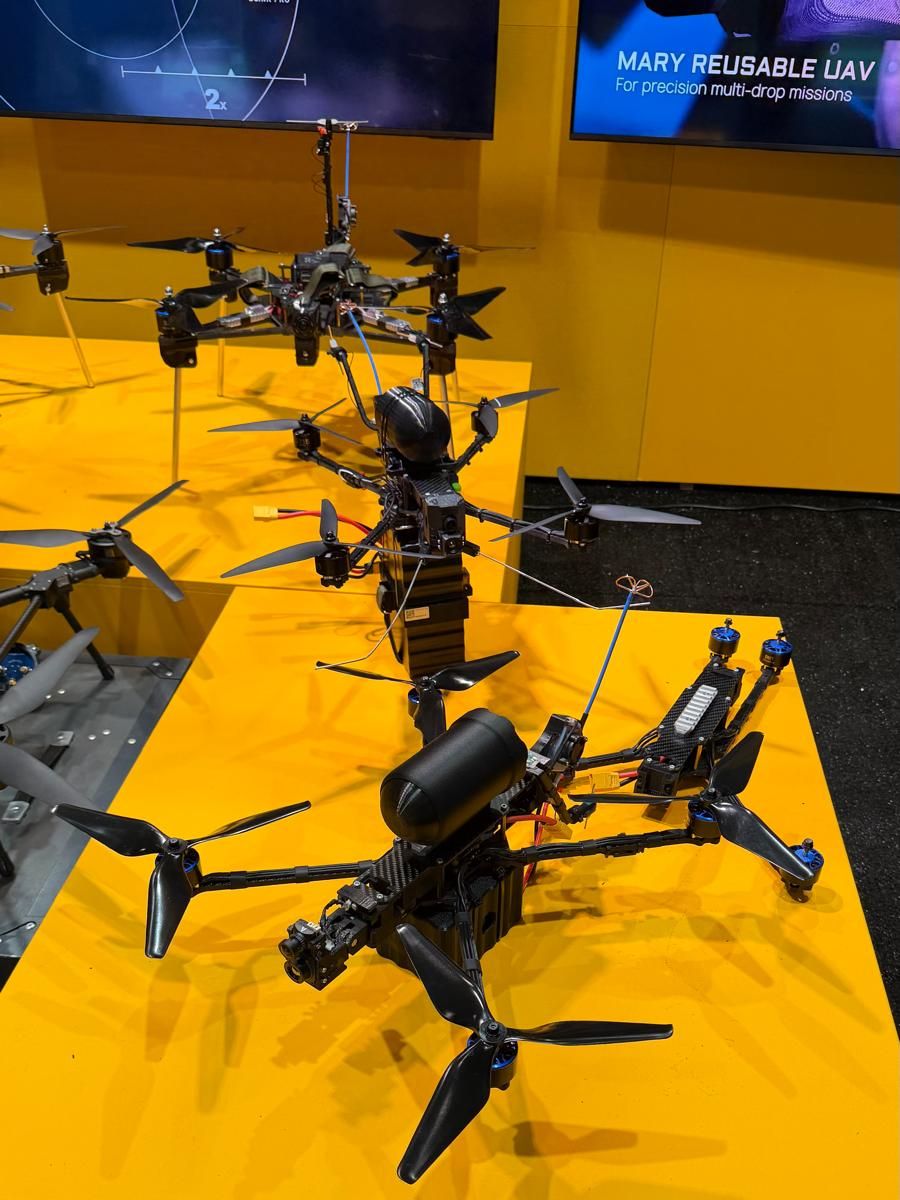
One yellow stand showed a family of strike and support drones: the MARY reusable UAV, pitched "for precision multi-drop missions" and paired on screen with a munition called Lumet, an aerial repeater and caged collision-proof quads. One screen claimed "80%+ engagement probability" from autonomous terminal guidance that holds the locked target "even after communication is lost." We could not confirm the maker.
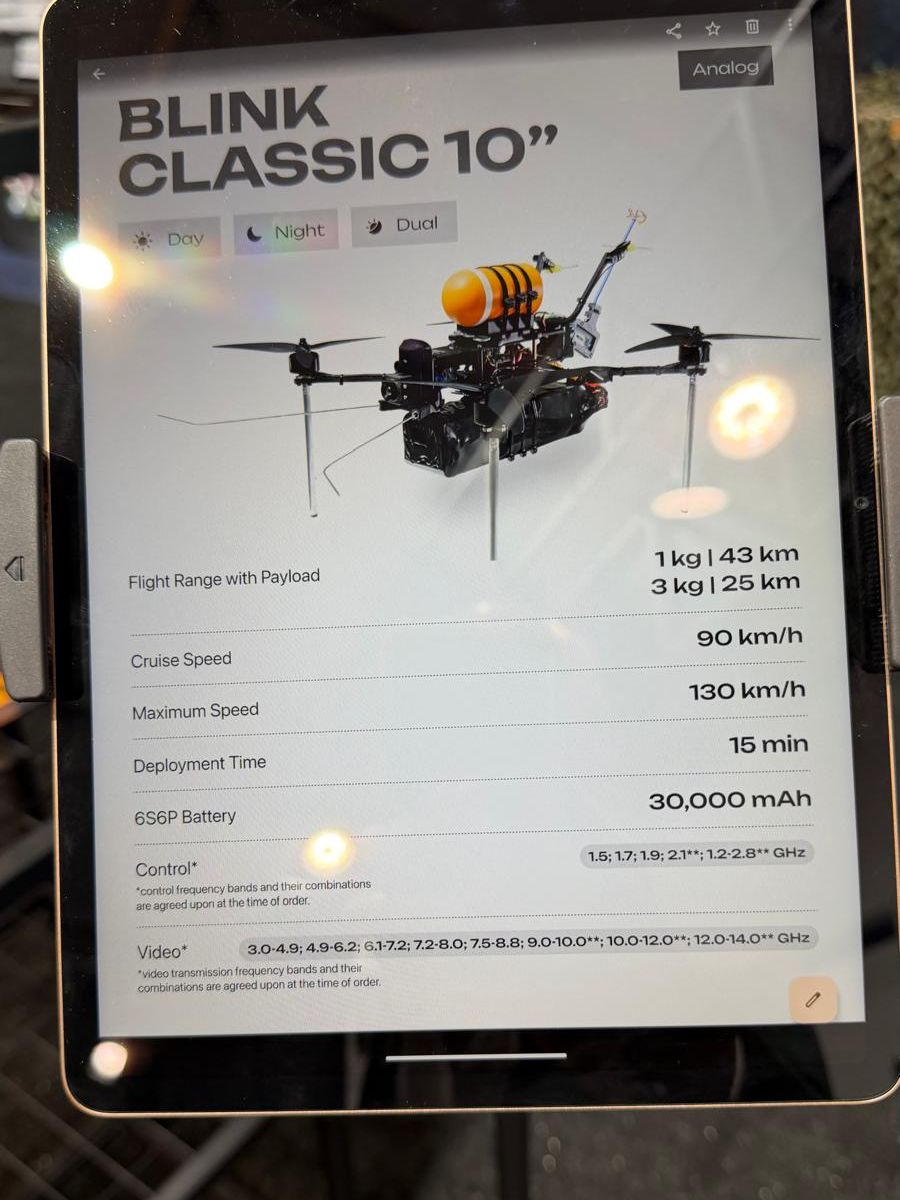
The Blink Classic 10" FPV listed 1 kg over 43 km or 3 kg over 25 km, 90 km/h cruise, 130 km/h maximum and a 15-minute deployment time. The Blink Mini 5" listed 0.5 kg over 3 km, 80 km/h maximum and up to 12 minutes in the air, with analog or fibre-optic control. Both came in day, night and dual-sensor versions.
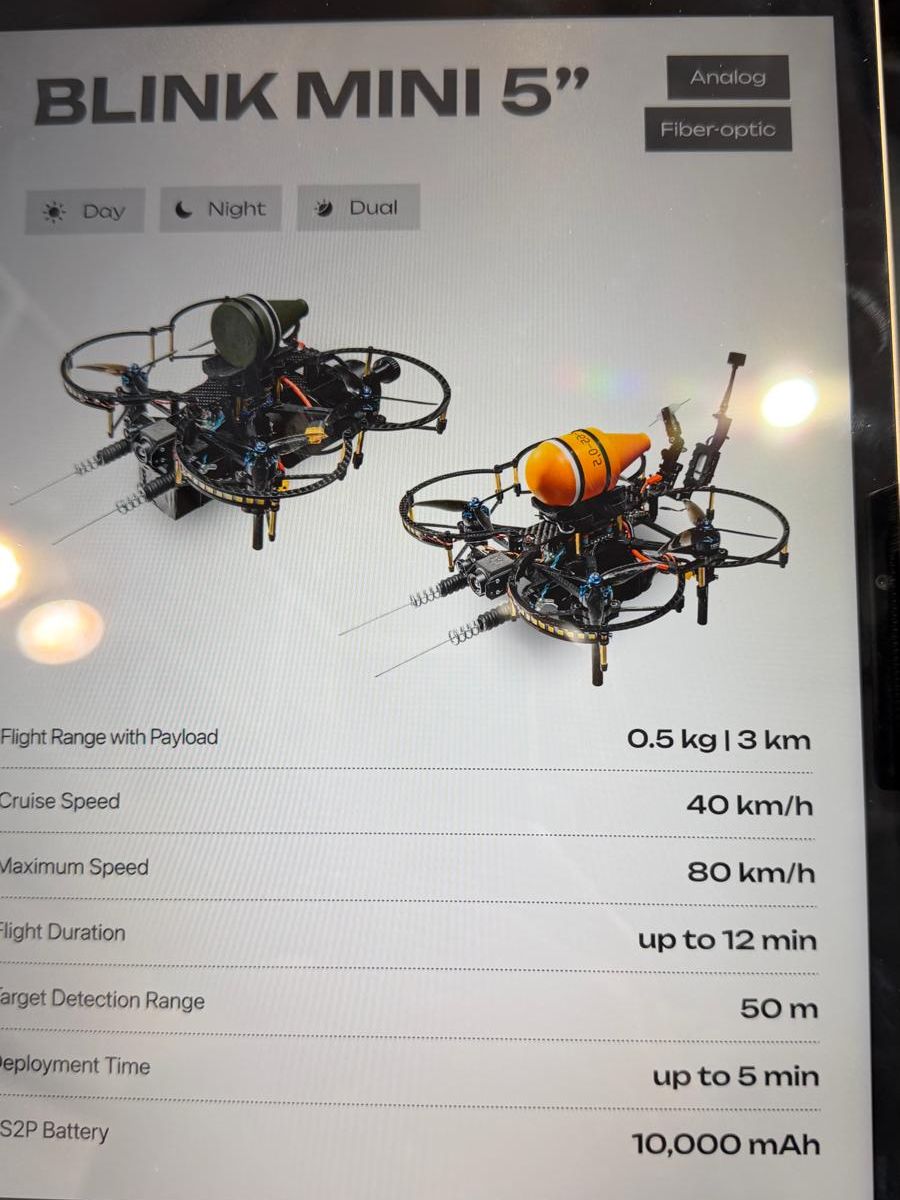
Fibre as a checkbox matters most for defenders: a fibre-guided drone radiates no control link, so RF direction-finding has nothing to hear and jamming nothing to jam. Many manufacturers now make fibre-guided FPVs (Rubryka), and the format has crossed the Atlantic.
Built for swarms, and built to be silent
Red Cat (booth 353) sells its FANG line of American-made FPVs as "low cost, reusable, retrievable." The 10-inch F10-P carries up to 2.0 kg and flies 10 km with payload or 15 km without; the larger two of its three airframes reach 97 mph (Red Cat). XTEND (booth 7207) builds FPV attack-drone kits for US special operations that fly over fibre optic or hardened radio links (Airforce Technology). Drones this cheap are bought by the thousand, which turns a single threat into a swarm.
Silence is now a selling point. AeroVironment's (booth 7515) Switchblade 300 is an electric, tube-launched loitering munition that grew out of an Army programme called SOAR, Silent Operating Aerial Reconnaissance, which asked for a backpackable drone with a very low acoustic signature (Designation Systems). AeroVironment says its small size and low acoustic signature make it hard to detect or track, even at close range (AeroVironment product catalogue).
Other small loitering munitions on the exhibitor list included UVision's Hero-30 (booth 1167), SpearUAV's tube-launched Viper (booth 1167), Rafael's Spike Firefly (booth 3225) and Anduril's Bolt-M (booth 151) (AUSA exhibitor list).
The defence side: everything on one mast
Counter-UAS stands converged on one picture: stack every sensor and effector on one mast or vehicle, and sell the software that ties them together.
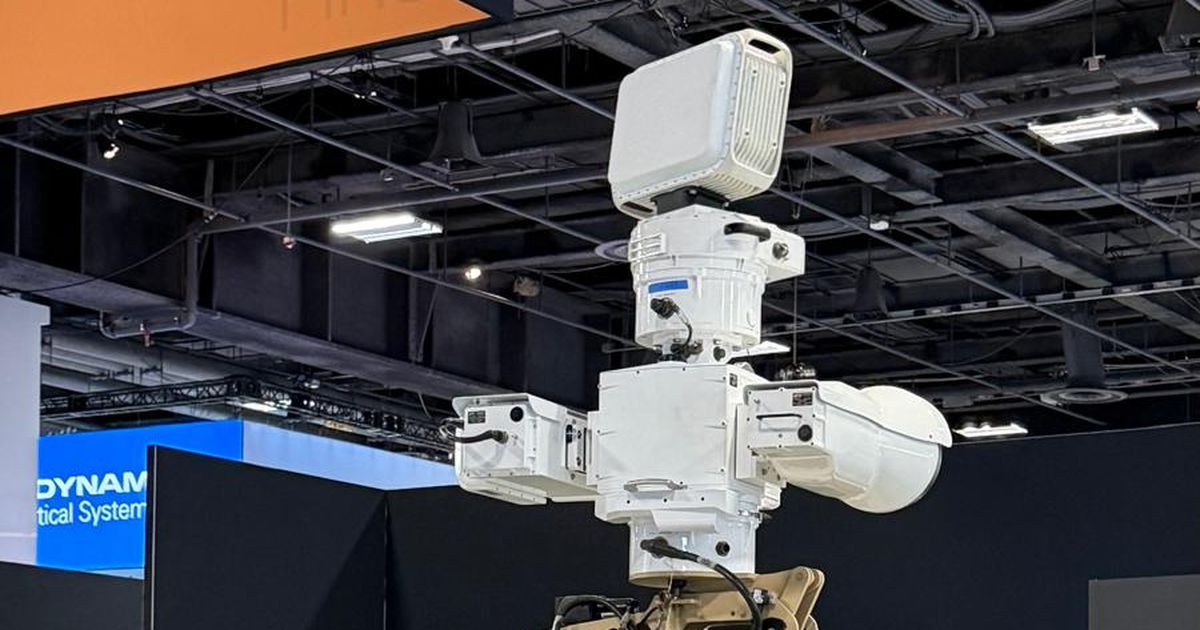
Twenty-Six Defense showed a vehicle mast with a radar panel, EO/IR turrets and interceptor drones: detection and defeat as one unit.
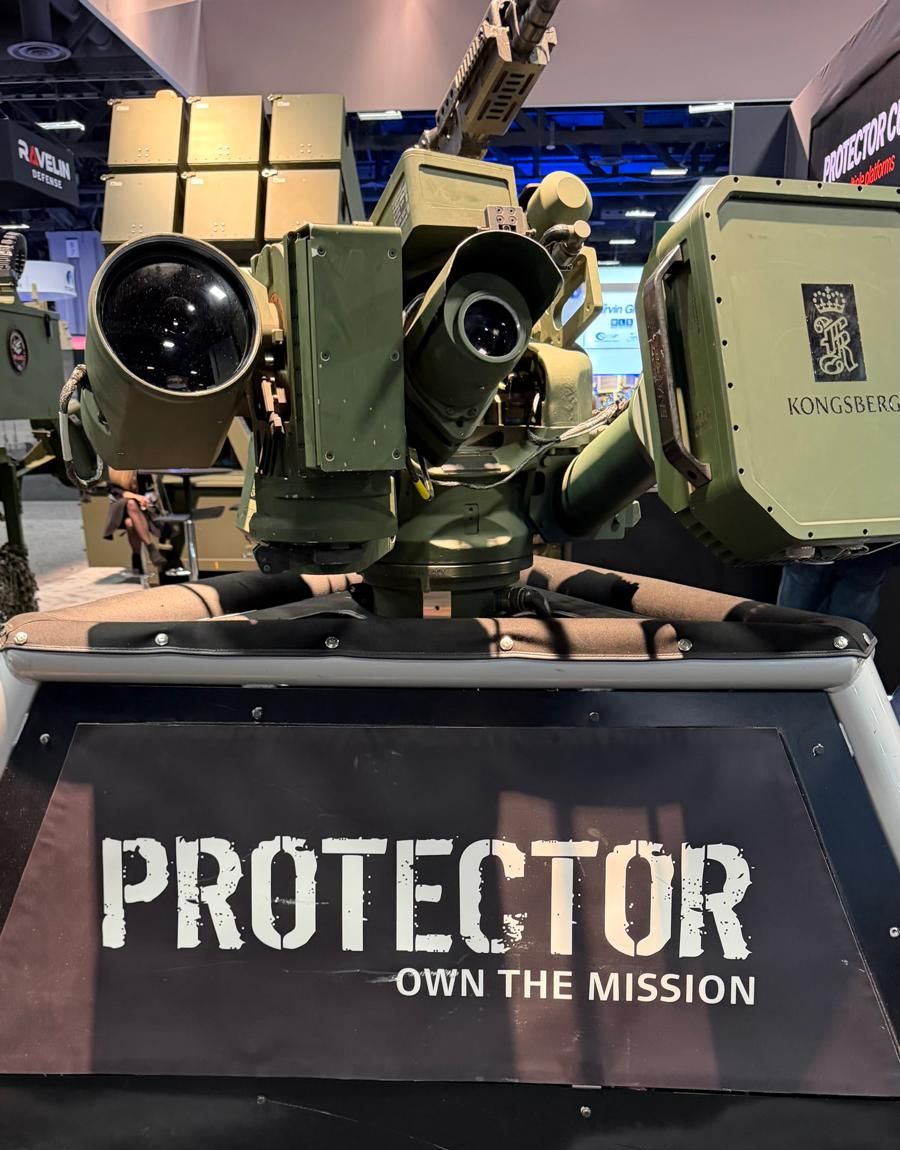
Kongsberg showed its Protector remote weapon station dressed for counter-UAS. At last year's AUSA, Kongsberg pitched adding counter-UAS to the US Army's existing CROWS stations through software and fire control, not new hardware (European Security & Defence).
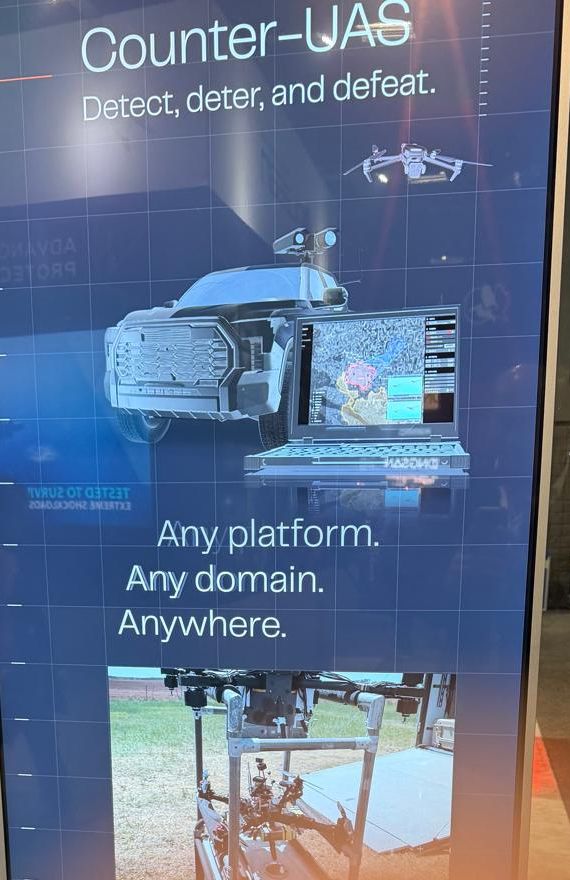
Honeywell Aerospace ran looping displays under the line "Counter-UAS: Detect, deter, and defeat. Any platform. Any domain. Anywhere.". The kiosk also showed the Honeywell 360 Display, a head-worn visor that stitches outside camera feeds into one view for vehicle crews and pilots (Honeywell).
Unwave, a Ukrainian EW maker, took part in the US Drone Dominance trials at Fort Carson (Militarnyi). EW still works against the many radio-controlled drones; it does nothing against the growing share on a fibre.
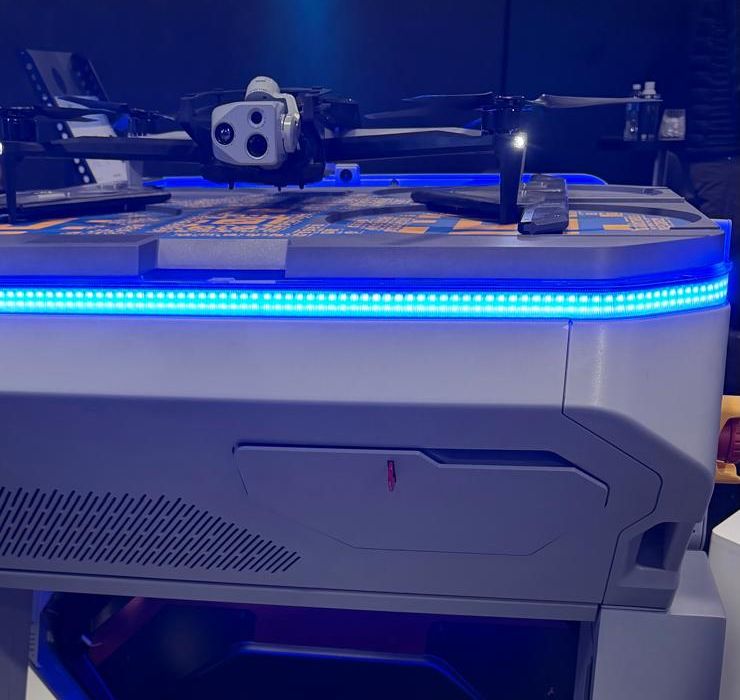
A Skydio X10 sat on its dock, which shelters and charges the drone and launches it in about 20 seconds without a pilot on site (UAV Coach). Docked drones confirm what a fixed sensor cued.
Electro-optics: two families
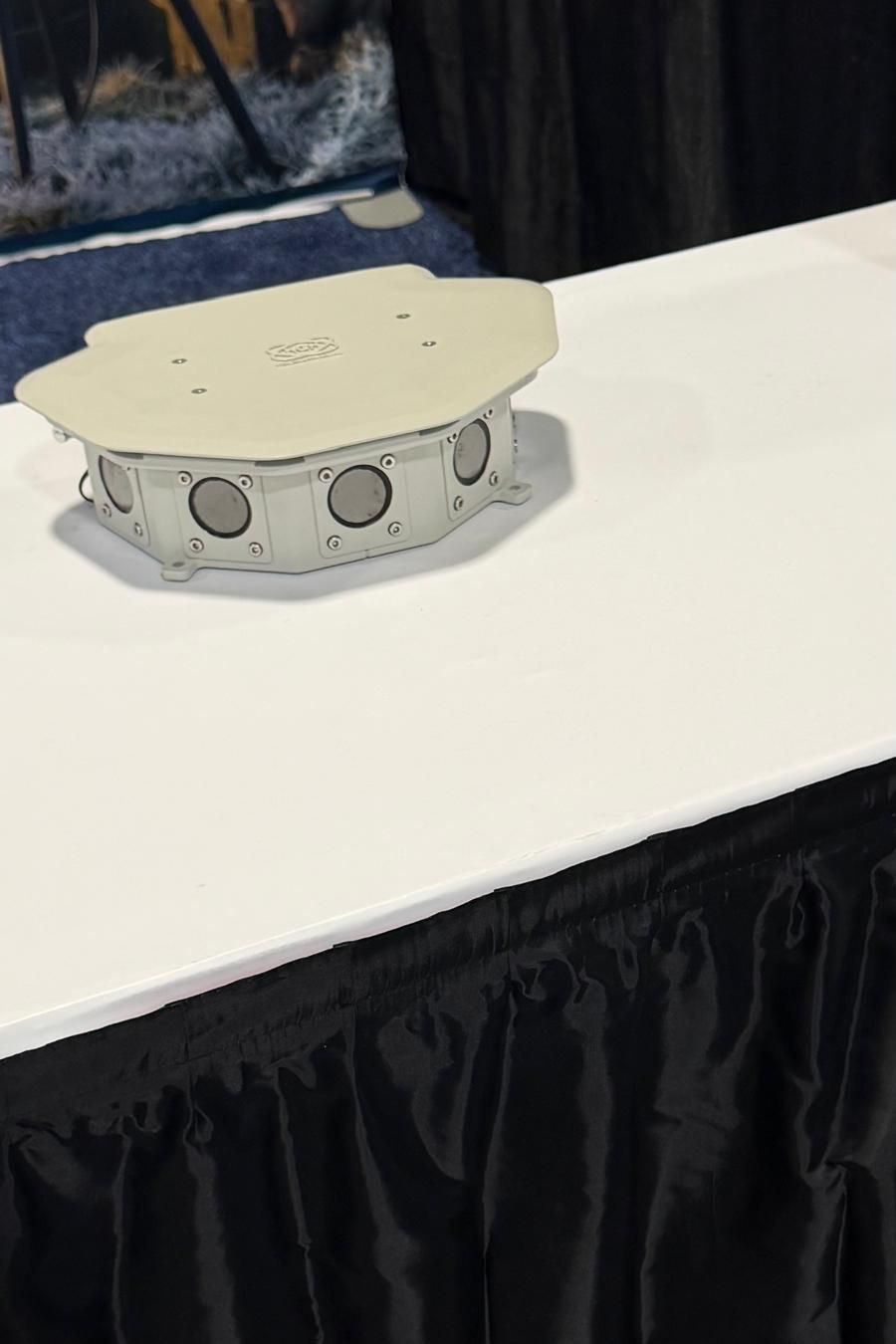
We think electro-optical sensing has to carry more of the load against small drones, and the floor showed two families. Cued trackers are narrow-field PTZ cameras that slew onto a target and follow it; they need a neighbouring sensor or C2 system to say roughly where to look. Wide-area search watches a whole sector with no cue, in two forms: scanning systems sweep a high-quality camera with a cooled detector across the horizon, and staring systems use an array of uncooled cameras that watch every direction at once. HGH showed both.
Thermal that watches the whole horizon
HGH Infrared Systems showed two panoramic thermal heads. The Spynel-X 3500 scans: its poster lists a 360° by 20° field of view, a 23,000 × 1,280-pixel panorama from a megapixel MWIR detector, 0.30 mrad spatial resolution, a 2 Hz scan rate and under 40 kg. HGH's own chart puts small-drone detection at the short end of its range bars, with aircraft much further out.
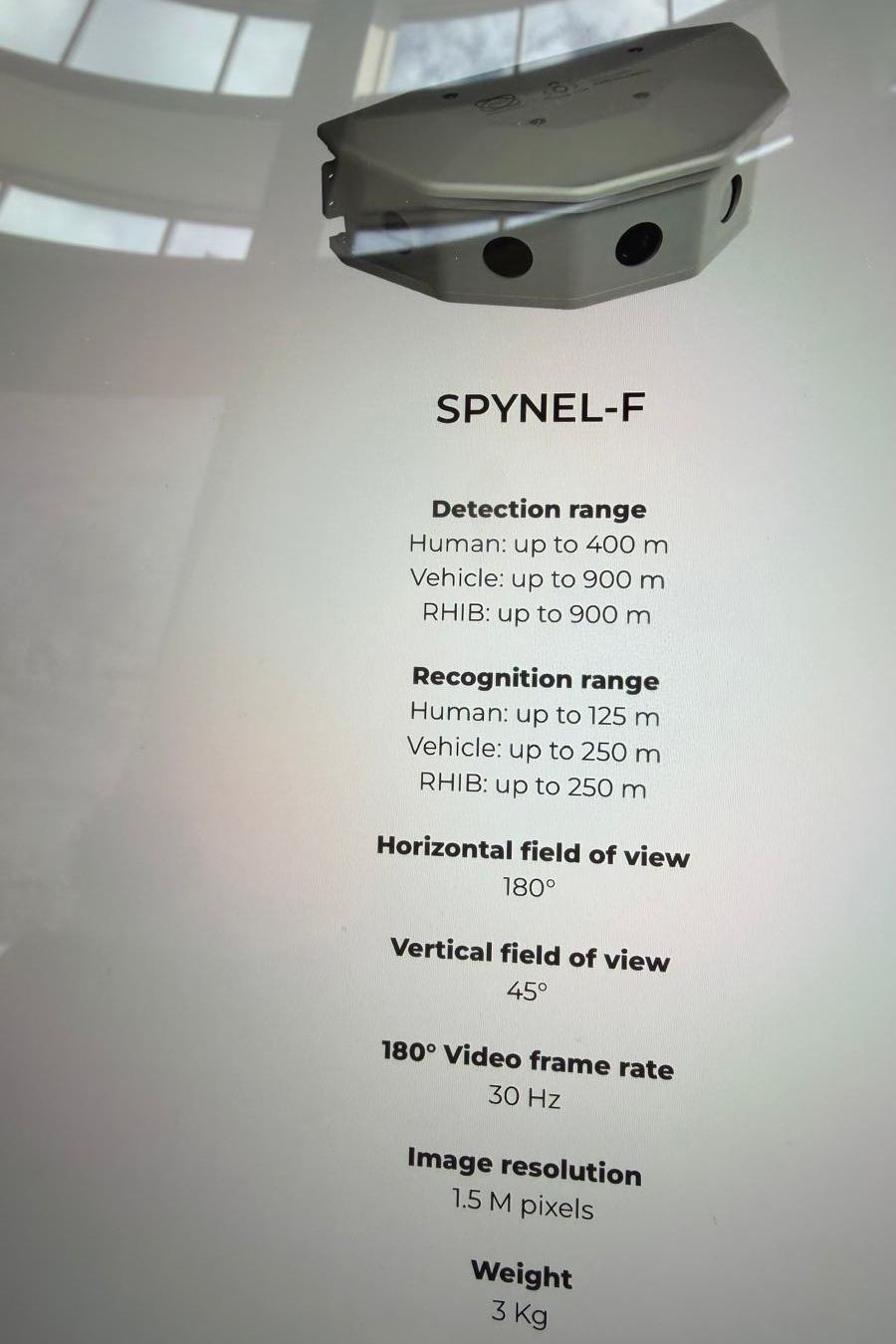
The Spynel-F stares: 180° horizontal, 1.5 megapixels, 30 Hz video, digitally stabilised, 3 kg. HGH says two units make a full 360° ring. The stand tablet listed a 45° vertical field of view; HGH's product page says 40°, and an earlier HGH page gave 10 Hz rather than 30 Hz (HGH, Spynel-F; HGH, Euronaval 2024 release).
What we take away
- Purpose-built robotic ground soldiers almost vanished, even at a US Army exhibition. The uncrewed ground vehicles on show were mostly converted trucks such as Humvee, Silverado and Oshkosh (Shephard), and drew little attention.
- Drones were everywhere, and they will come in swarms. Every size, range and payload, all cheap and working day and night in almost any weather. Some fully autonomous with a small radar cross-section, others fibre-controlled and RF-silent.
- The defenders know they are exposed, and that drones will target them first. Remote-weapon-station and site-protection makers openly say their systems are vulnerable, and are loading them with radars, electro-optical and sometimes acoustic sensors.
- It's a cat-and-mouse game, but one thing doesn't change. A drone cannot hide its body or its heat: motors, batteries and electronics run hot.
Bottom line: choose a C-UAS that protects forces 24/7 against swarms of small, silent, autonomous drones. The one signature they cannot hide is thermal.
- Shephard, "AUSA 2026 preview: Uncrewed systems and platforms to defend against them set to feature" — https://www.shephardmedia.com/news/landwarfareintl/ausa-2026-uncrewed-systems-and-defending-against-them-set-to-feature/
- Rubryka, "Solutions to win: Brave1 cluster builds catalog of Ukrainian drones using fiber optics," 25 Dec 2024 — https://rubryka.com/en/2024/12/25/katalog-ukrayinskyh-droniv/
- Militarnyi, "Ukrainian EW System From Unwave Participated in Drone Dominance Tests in USA" — https://militarnyi.com/en/news/ukrainian-ew-unwave-drone-dominance-in-usa/
- HGH Infrared Systems, "Spynel F" product page — https://hgh-infrared.com/was/products/spynel-f/
- HGH Infrared Systems, "HGH Unveils SPYNEL-F and USV-Based Surveillance Solutions" — https://hgh-infrared.com/hgh-unveils-spynel-f-and-usv-based-surveillance-solutions/
- European Security & Defence, "AUSA 2025: Kongsberg looks to add C-UAS capability to US Army's CROWS remote weapon stations," Oct 2025 — https://euro-sd.com/2025/10/major-news/47395/kongsberg-crows-c-uas/
- Honeywell Aerospace, "Honeywell 360 Display" — https://www.honeywellaerospace.com/us/en/products-and-services/product/hardware-and-systems/cockpit-systems-and-displays/honeywell-360-display
- UAV Coach, "Skydio Launches a Dock for the X10" — https://uavcoach.com/skydio-x10-dock/
- Shephard, "AUSA 2026: Is uncrewing the crewed the future of large UGVs?" — https://shephardmedia.com/news/landwarfareintl/ausa-2026-is-uncrewing-the-crewed-the-future-of-large-ugvs/
- Red Cat, "FANG" product page — https://redcataerial.com/solutions/fang/
- Airforce Technology, "XTEND FPV drone kits contract" — https://www.airforce-technology.com/newsletters/xtend-fpv-drone-kits-contract
- Designation Systems, "AeroVironment Switchblade" — https://designation-systems.net/dusrm/app4/switchblade.html
- AeroVironment, 2025 Product Catalog — https://www.avinc.com/wp-content/uploads/2026/04/2025_ProductCatalog.pdf
- AUSA, "2026 Annual Meeting exhibitor list" — https://meetings.ausa.org/annual/2026/exhibitor_exhibitor_list.cfm
- Exhibitor displays and spec sheets photographed on the AUSA 2026 show floor, 12–14 October 2026.
Independent commentary by GOTEAM. Not affiliated with or endorsed by any organisation named above. Figures are as shown on vendor displays or published by their sources and have not been independently verified. Photos taken by GOTEAM on the public show floor.
Working the counter-drone problem?
We build passive thermal detection for sites that need a track without waiting for the drone to transmit.