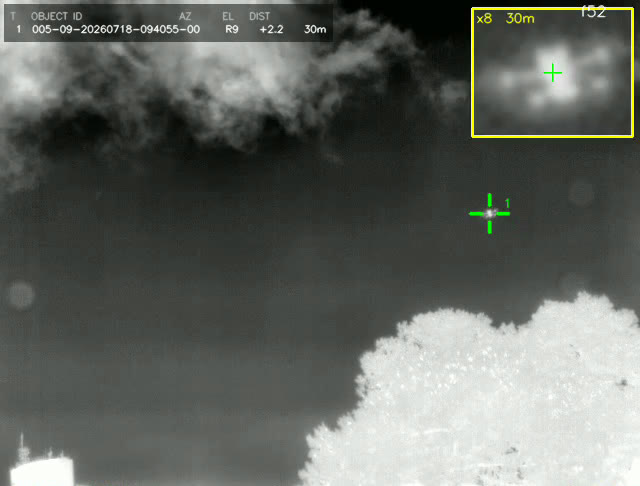
For years the honest answer to "what can we legally do about drones over our site?" was almost nothing — federal counter-UAS authority sat with a short list of agencies, and everyone else watched. That just changed. The C-UAS Interim Final Rule, the framework built out under the SAFER SKIES Act, widens who can stand up a counter-drone program and puts real authority in reach of state and local agencies and critical-infrastructure operators for the first time. The rule sorts that authority into two tiers — Tier 1, "Detection and Warning," and Tier 2, "Mitigation" — and that split is the whole story for a buyer.
The reflex, understandably, is to go shopping for the dramatic part — the jammer, the interceptor, the thing that knocks a drone out of the sky. I want to argue the opposite. The rule didn't create one new market. It created two, on very different clocks — and the winning move is to build the fast one first.
Read the rule as two lanes, not one
Strip the framework down to what it means for a buyer and it separates cleanly into two lanes:
- Detection and tracking — knowing a drone is there, where it is, and what it is. Passive sensing here sits outside the gated, authorized-equipment machinery. Nothing to get listed, no spectrum coordination, no waiver to wait on. You can buy it, deploy it, and operate it now.
- Mitigation — interdiction, jamming, takeover, kinetic. This is where the real gates live: authorized-systems constraints, coordination requirements, approvals, and the review cycles that come with anything that transmits or brings a drone down. Legitimate — and slow.
Both lanes matter. But they do not move at the same speed, and treating them as one line item is how a program stalls for a year waiting on the hard half while the site stays blind.
| Mitigation-first path | Detection-first path | |
|---|---|---|
| Deploy today? | No — gated approvals first | Yes — clear to operate now |
| Spectrum / FCC step | Coordination or waiver required | None — passive EO/IR emits nothing |
| Who can buy it | Narrow — authorized operators | Broad — far larger eligible base |
| Time to first value | Procurement + approval cycle | Days to a live picture |
| Builds the case for more? | It is the hard step | Yes — generates the record that justifies mitigation |
| Risk if you wait | — | Every day unprotected is a day of blind sky |
Re-strategy #1 — Lead with detection, because you can actually deploy it
The simplest reason to lead with detection is that you're allowed to, today. A detection layer doesn't need to clear the authorized-equipment process before it earns its keep. While the mitigation side of your plan moves through approvals, the detection side is already watching the sky, logging incursions, and telling you whether you even have the problem you think you have. You convert budget into protection in days, not quarters.
There's a procurement truth underneath this too: the pool of buyers who can legally operate detection is far larger than the pool cleared for mitigation. If your program only makes sense once the jammer is approved, it's fragile. If it delivers value the moment the sensors are up, it's fundable.
Re-strategy #2 — Go passive, because emitting is now a liability
Once you're building detection-first, the next question is which detection. And here the rule quietly rewards the passive approach. Anything that transmits to find a drone — active RF, radar emissions — drags you back toward the coordinated, gated side of the world and lights up your own position while doing it.
Passive electro-optical / infrared does neither. It emits nothing: no spectrum to license, no signal to coordinate, no beacon announcing where your sensor sits. And it sees a threat the RF-based tools structurally cannot — the autonomous, pre-programmed drone flying with its radio off. You can't jam what isn't transmitting, and you can't detect-by-RF what isn't transmitting either. A heat signature can't be switched off. The drone that matters most — the quiet one, flying a loaded waypoint mission — is exactly the one a thermal camera still sees and a radio scanner never will.
Re-strategy #3 — Detection is what earns you the rest
Here's the part that gets missed. Detection isn't just the safe first purchase — it's the thing that unlocks everything downstream. Before anyone signs off on the authority to bring a drone down over your site, they'll want to know the threat is real: how often, what pattern, what kind of aircraft, at what points on the perimeter.
A detection-first program generates exactly that record. Every incursion becomes a logged, time-stamped, imagery-backed event — not an operator's word that "we've been seeing drones." That evidence is what makes the case for the harder authorities, and it's the same evidence that stands up after an event, when someone asks what you knew and when. You can't skip detection to get to mitigation. Detection is how you get to mitigation.
Re-strategy #4 — Buy layer-ready, and speak up before the window closes
Two practical moves while the framework is still settling:
- Buy for the layered end state. Detection-first doesn't mean detection-only forever. Pick a detection layer that hands off cleanly — a track and a confirmed image out to your command system and whatever mitigation you're eventually cleared to run. You want the sensor you deploy now to still be the sensor feeding the effector later.
- This is an interim rule with a comment window. The framework isn't frozen — the agencies are taking public comment before it finalizes. If your operating reality has a wrinkle the rule doesn't handle, now is when that feedback actually lands. Operators who engage during the comment period shape the version they'll live under.
The move
The new rule is a genuine opening — the first time a lot of sites can do more than watch. But the fastest, lowest-friction, most-fundable slice of that opening is the detection layer, and the cleanest detection layer is the passive one that emits nothing and still sees the quiet drone. Start there. Build the record. Let it earn the rest.
That's the layer we build. If you're standing up a program under the new framework and want to see passive thermal detection running on real hardware — with real detections, not a slide — we'll show you: goteam.co.il/management.html
— Baruch
Primary source: “Counter-UAS Authority for State, Local, Tribal, and Territorial Law Enforcement and Correctional Agencies” — DOJ & DHS Interim Final Rule under the SAFER SKIES Act, 28 CFR Part 124 & 6 CFR Part 124, Federal Register doc. 2026-13609 (91 FR 41466), published July 6, 2026; effective July 1, 2026; comments close September 4, 2026. Note: the detection-tier reading above is GOTEAM's operational interpretation, informed by the Israel-Ohio Technology Engagement Center (IO_TEC) brief, and is written for planning purposes — it is not legal advice. Confirm authorities and equipment eligibility for your specific site and jurisdiction with counsel before you deploy.
Standing up a program under the new rule?
We'll scope a detection-first pilot for your site — passive thermal, live tracks to your hub, layer-ready for whatever you're cleared to add next.