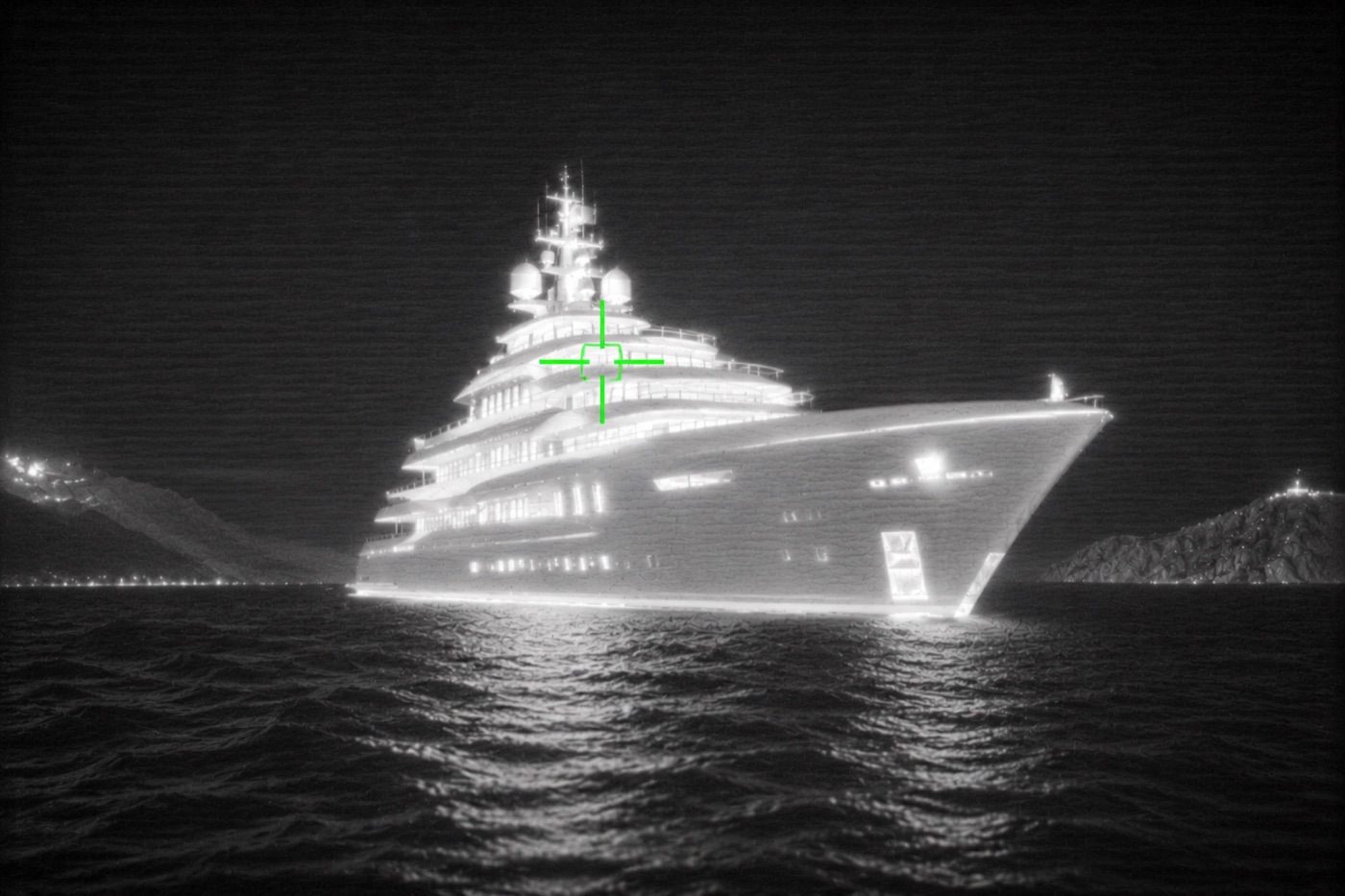
This week the news carried a striking image: two Russian warships escorting a luxury superyacht linked to Vladimir Putin (reported by The Moscow Times). Politics aside, I read it as a threat model: someone decided a vessel carrying a protected principal needs a military layer around it.
You will not get a warship escort. Neither will your principal. And the threat that worries protection teams most doesn't arrive by sea. It arrives at 40 knots, a metre above the waves or over the marina breakwater, weighs two kilograms, and costs less than a dinner ashore.
Why VIPs are the hardest case
A principal moves — villa to motorcade to marina to open water — and the adversary's cheapest tool moves with them. Around a VIP, a small drone rarely looks like an attack at first:
- Surveillance. Guest lists, security layout, shift changes, arrival routines — mapped from 400 metres up, silently, over days.
- Intrusion of privacy. For public figures, a photograph taken over a deck is a business model. For their security team, each of those flights is also a dry run someone else can study.
- The escalation you plan for. The platform that carries a camera carries other payloads. If the surveillance flights went unnoticed, the last flight will too.
Why the usual answers don't travel
The counter-drone toolkit of a fixed military site travels badly with a principal, and worst at sea:
- Radar. A yacht's navigation radar was never meant for a small, slow, low target against sea clutter. Dedicated counter-drone radar means active emissions from a civilian vessel, with licensing questions in every port state.
- RF detection. A harbour is one of the noisiest RF environments there is, and the most worrying drones may fly a pre-programmed route, radio silent, with nothing to intercept.
- Jamming. Illegal in most civilian jurisdictions, hazardous in a crowded anchorage, and impossible to justify port to port.
Every active system also announces itself. Emissions can be detected, catalogued and planned around.
Passive thermal was made for this
Here a passive infrared layer is the only option that fits every constraint. It emits nothing: no licensing friction in any port, nothing for an adversary to detect. It works the same at 3 p.m. and 3 a.m., and night is when a lit yacht is most exposed and a drone is invisible to the eye. It sees the aircraft's heat, not its radio, so a silent drone is just as visible. And it is discreet: a small sensor on a mast or superstructure, not an antenna farm.
The hard part is picking a drone out of a moving sea-and-sky scene — a handful of warm pixels among waves, birds and sun-heated clutter. That is the problem we've spent years on, with an algorithm that keeps improving from field data. The sensor is the easy purchase; the algorithm is the capability.
A protection detail is not a SOC
A VIP detail is a handful of people with full hands, not a security operations centre, and our management system was built for that case:
- Alerts where the team is. Live map, feeds and threat-graded tracks on a phone, in a pocket, on the bridge.
- Evidence, not arguments. Every detection is stored with its annotated video and kept until you delete it. Legal action against a stalker or an intrusive operator starts with proof: the aircraft, the track, the time. A detection nobody can review is a rumor.
- One hub for a moving life. Yacht, residence and motorcade vehicle all report to the same picture, over cellular or satellite.
- Nothing to maintain aboard. Health is monitored remotely with trend history; algorithm updates reach every unit over the air in seconds.
- Plays with the wider detail. SAPIENT (BSI Flex 335 v2) output feeds whatever command system the protection operation already runs.
The honest summary
Two warships around a superyacht is a threat assessment expressed in steel. Most principals will express theirs differently: a silent sensor that watches the sky, an algorithm that has seen ten thousand hours of it, and a system that turns every incursion into evidence a lawyer or a liaison officer can use.
If you run protection for a principal — afloat or ashore — we'll show you the system on real hardware, with real detections: goteam.co.il/management.html
— Baruch
Protecting a principal, not a perimeter?
We'll walk you through a live deployment and scope a pilot — vessel, residence or motorcade.