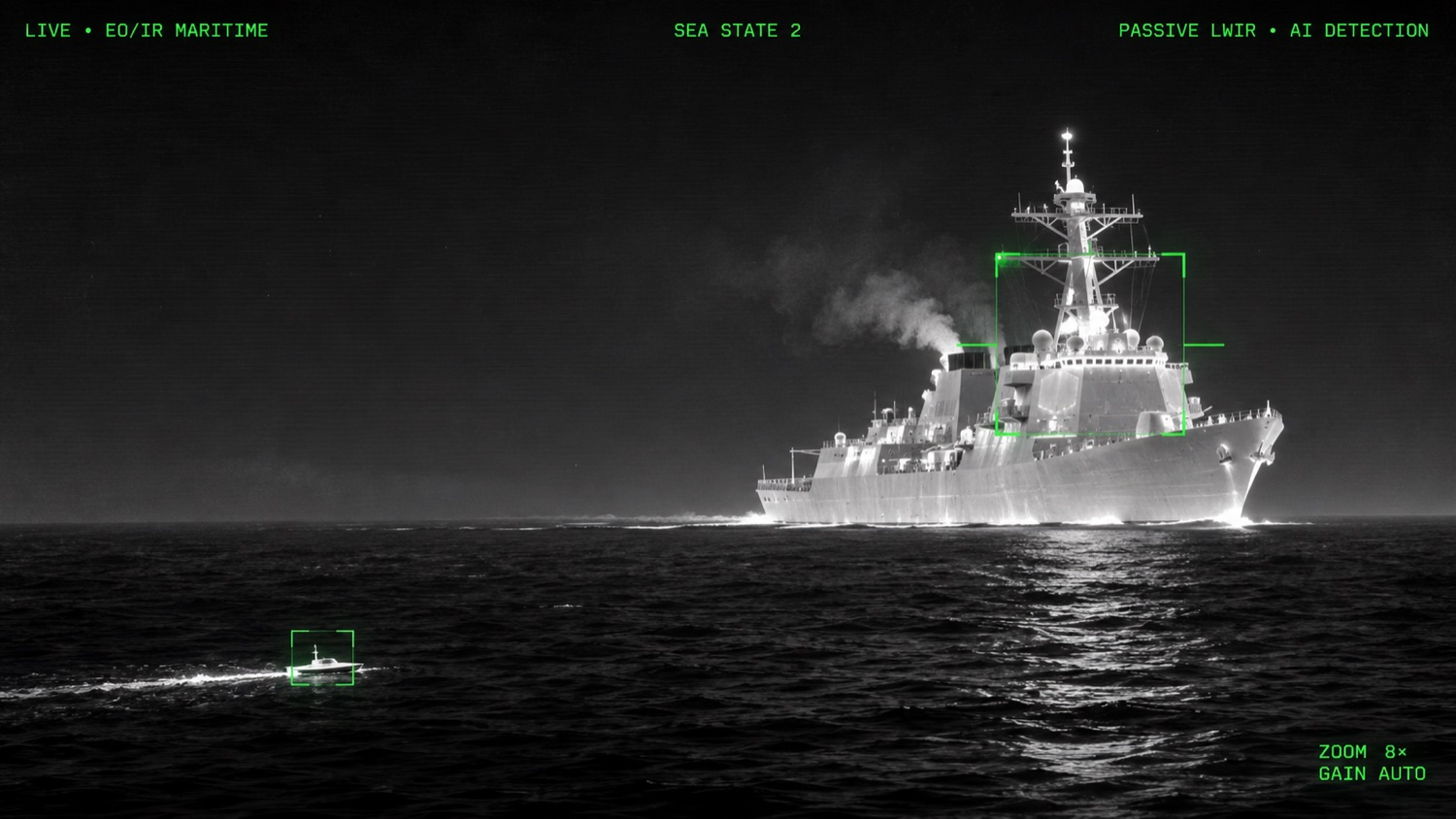
A navy is being taken apart, and not by another navy. Within days, uncrewed systems reportedly struck more than a dozen additional Russian vessels in a single wave of a campaign open-source trackers have been cataloguing for months (open-source summary). As an engineer, what I see is a number: the thing doing the striking costs a rounding error against the thing it strikes.
A warship is a nation's most expensive moving object. The craft hunting it — a converted boat hull, or a small aircraft with a camera and a warhead — is assembled from parts you can buy. When the attacker's cost approaches zero and the defender's stays at hundreds of millions, the question is no longer who is stronger but who can afford to lose the exchange, over and over.
The asymmetry is the point
Ship defences were designed against a scarce, expensive threat: a handful of missiles, launched by an adversary who also had to pay for them. That logic breaks when the threat is cheap and abundant. You cannot spend a million-dollar interceptor on every ten-thousand-dollar drone and stay solvent, or armour against a swarm that simply sends one more.
The conclusion the professionals have already reached: you don't win this by out-building the threat. You win it by seeing it first — early and cheaply enough to meet a cheap attack with a proportionate answer instead of an expensive panic.
Sun Tzu and the supply line
This is old thinking on new hardware. Twenty-five centuries ago Sun Tzu argued that the highest skill in war is to make the enemy unable to fight: attack his plans and his logistics, avoid his strength, and strike where he is unprepared. The drone is the instrument that doctrine was waiting for. Read with a small uncrewed aircraft in mind, the maxims stop sounding ancient:
- Subdue the enemy without fighting. The aim is not to sink the fleet but to make the sea unusable, so a navy neutralises itself by staying in port.
- Attack where he is unprepared; appear where you are not expected. A drone skims the wave-tops or crosses the breakwater on the one bearing nobody is watching.
- Be so formless the enemy has no front to defend. There is no line to hold against something that can arrive from any direction, at any hour, in any number.
- Strike the logistics, not the army. Break the ports, anchorages, resupply runs, tankers and tenders, and the fighting ships become stranded assets — undefeated and irrelevant.
- Let cost, not courage, decide. Sun Tzu warned that no nation profits from a long war. A weapon that costs less than the cargo it destroys can lose the exchange a hundred times and still come out ahead.
Through that lens the Black Sea snaps into focus: a patient, distributed attack on a fleet's logistics and freedom of movement, harbour by harbour, until one of the most powerful navies afloat is reduced to hiding in port. The indirect approach is now available to any side that could never build a navy of its own.
The counter is as old as the threat: you win by knowing. Whoever sees movement early keeps the freedom to act. You cannot fortify every metre of a supply line, but you can watch the approaches to the nodes that matter — and an ambush that has already been seen is just an expensive way to announce yourself.
Not only a warfront problem
The same cheap uncrewed systems, minus the warhead, are already a civilian problem, arriving over your deck, terminal or platform:
- Ports and terminals. Dense, high-value, lightly defended, with predictable routines. A drone needs no explosives: presence alone halts operations, and reconnaissance maps the site for whoever comes next.
- Offshore energy. Rigs, wind farms and their support vessels sit far from any responder, lit up against a cold sea and easy to find from the air at night.
- Commercial and private vessels. From the bridge, "someone's hobby drone" and "a rehearsal" look the same. By the time intent is obvious, the decision window has closed.
- Chokepoints and anchorages. Where ships slow down and cluster, one operator on shore can watch — or worse — dozens of hulls at once.
Detection is the cheapest first move
You cannot defend against something you have not detected, so in an asymmetric fight the highest-leverage investment is knowing, early and reliably, that the cheap thing is inbound. That detection layer has to obey the same economics:
- Passive, so it doesn't announce itself. A radar or an RF jammer is an emitter — detectable, catalogued, and in most civilian waters a licensing and legality problem. A passive thermal sensor emits nothing.
- Thermal, because the threat is small and often flies at night. Infrared sees the aircraft's own heat against a cold sea, day or night. A drone on a pre-programmed route with its radio off has nothing to intercept, but its engine and body still glow.
- Cheap enough to be everywhere. A passive sensor is inexpensive enough for every quay, platform and hull that matters, so coverage isn't rationed to the one asset you could afford to protect.
What's actually hard is picking a small aircraft out of a moving sea-and-sky scene — a few warm pixels among waves, birds and sun-heated clutter. That is an algorithmic problem, not a camera off a shelf, and the one we have spent years on, with a detector that keeps improving from real field data. The sensor is the easy part; the algorithm is the capability.
What changes for a civilian operator
The lesson from a burning warship is not "buy weapons." The threat model has inverted, and detection is now the cheapest insurance you can hold:
- See it where the people are. Live map, feeds and threat-graded tracks on a phone or a control-room screen, not a specialist console.
- Evidence, not arguments. Every detection is stored with its annotated video and kept until you delete it, so a harbourmaster, insurer or court starts with proof: the aircraft, the track, the time.
- One picture across many sites. Quay, platform and patrol boat report to the same hub, over cellular or satellite, so a port isn't twelve separate blind spots.
- Plays with what you already run. SAPIENT (BSI Flex 335 v2) output feeds an existing command or VTS system, rather than becoming one more island.
The honest summary
The Black Sea is a demonstration, in the most expensive terms possible, of a rule for anyone with something on the water: the cheap thing wins the exchange unless you see it coming. You will not out-spend a threat that costs less than the fuel you burn looking for it. You can see it first — with a sensor that emits nothing, watches in the dark, and turns every incursion into evidence.
If you protect a port, a platform, a fleet or a single vessel, we'll show you the system on real hardware, with real detections: goteam.co.il/management.html
— Baruch
Own something on the water?
We'll walk you through a live deployment and scope a pilot — port, platform, fleet or a single hull.