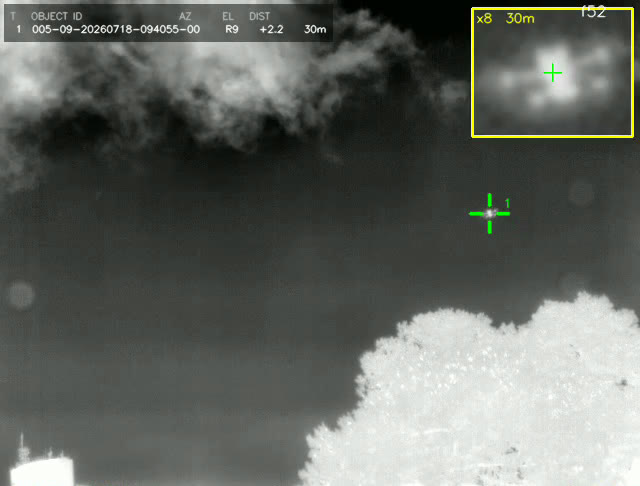
Counter-UAS sales floors sell range: a cooled mid-wave sensor, continuous zoom, "detection out to five kilometres." For the threat most sites face, that is the wrong thing to optimise, and the architecture it forces carries risks the brochure never lists.
Two questions keep getting merged: which thermal band you use, and whether the camera moves. The first is a sensor choice. The second decides whether you can see a swarm at all.
Two kinds of thermal, honestly
Thermal counter-UAS sensors divide by infrared band:
- Uncooled LWIR (long-wave, 8–14 µm) uses a microbolometer: no cryocooler, low power, mechanically simple, inexpensive and rugged. It reads a drone's airframe against a cool sky well at perimeter-defence ranges.
- Cooled MWIR (mid-wave, 3–5 µm) uses a photon detector chilled by an integrated cryocooler. It is more sensitive and reaches farther, but costs ten to fifty times more, draws far more power, needs cool-down time, ships with a cooler whose service life is measured in hours, and usually carries export-control baggage.
Both are real tools; the question is which architecture fits the mission. The MWIR-plus-gimbal tier was inherited from platforms built to watch for large, fast aircraft, and against small drones the seams show.
| Cooled-MWIR PTZ tier | GOTEAM Flyer | |
|---|---|---|
| Sensor | Cooled MWIR (cryocooler) | Uncooled LWIR |
| Optics | Continuous-zoom pan-tilt gimbal | Fixed wide-field stare |
| Field of view | Narrow — one sector at a time | The whole scene, every frame |
| Multi-target | Time-sliced — one lock at a time | Native — all targets at once |
| Search | Needs a radar / RF cue to slew | Always searching, no cue needed |
| Moving parts | Gimbal + cryocooler | None |
| Reliability (MTBF) | Limited by motors & cooler wear | No wear items — far higher |
The scanning gap
A pan-tilt-zoom sensor sees one narrow field of view at a time. While it looks at sector A, a drone crossing sector B is not observed, and an adversary only has to arrive during that blind time.
High-end systems avoid searching: they wait to be cued by radar or an RF analyser, then slew to the bearing. That works against a target that announces itself, and fails against the fastest-growing threat: a small, autonomous, radio-silent quadcopter with a radar cross-section barely above the noise. The most dangerous drone is the one your camera was never told to turn toward.
One camera, one target
A PTZ cannot really track several targets. One aperture points one direction, so it time-slices: slew to A, dwell, slew to B, dwell, and every other target goes unwatched. As the count climbs, tracks drop or get mis-associated, and the picture falls apart when it is most crowded. A coordinated swarm is the designed-in failure mode.
Fixed-stare inverts this. Every target in the field is imaged in every frame, and the detector runs across the whole frame on every pass. One drone or twenty, the latency is the same and no track is put down to look elsewhere.
Range is a vanity metric
Two things undo the long-range pitch in the small-drone fight:
- Your effectors are short-range. RF jammers, nets, interceptors and most directed energy frequently engage well under a kilometre. A track at five kilometres you cannot touch until five hundred metres is a number, not a defence.
- Identification needs pixels on target. At five kilometres a small drone is a warm smudge: a track, not an identification. On any sensor, calling drone-versus-bird needs it closer, so the decision happens inside the near envelope anyway.
The real job is confident, simultaneous, multi-target detection inside the envelope where you can actually act. Long range legitimately matters for fast fixed-wing threats, standoff attack, or critical infrastructure with long, open approaches; if that is your mission, buy the range.
How GOTEAM gets there instead
We put the intelligence in the software, not a half-million-dollar sensor. GOTEAM Flyer stares, with a wide field, no moving parts, no blind time and no cue required, and a purpose-trained neural network does the reaching:
- Capture the raw 16-bit thermal frame, not a compressed 8-bit picture, so faint targets survive.
- Suppress the sky and clutter, leaving the sharp hot peaks a drone makes.
- Detect with a network trained on tens of thousands of verified thermal drone frames.
- Confirm each target across frames by motion, so sensor noise and static hot spots never raise an alarm.
- Range and hand off a live map track and annotated clip to your hub and any connected C2.
With no gimbal motors, slip rings or cryocooler, there are no wear items to fail. A fixed-stare node's mean time between failures (MTBF) is not dragged down by a mechanism that moves thousands of times an hour or a cooler with a rated service life, so it keeps watching, unattended, far longer between service visits.
If you protect a site, a perimeter or a fleet, we'll show you the system on real hardware, with real detections: goteam.co.il/management.html
— Baruch
Have a perimeter to watch?
We'll walk you through a live deployment and scope a pilot — fixed sites, mobile, or a fleet of nodes.