I spent decades building thermal-imaging detection at SCD before founding GOTEAM. If those years taught me one thing, it's this:
A thermal core you can buy. What you cannot buy is an algorithm that reliably picks out a drone — a handful of warm pixels, moving, in a cluttered sky full of birds, clouds and heat noise — and does it at the edge, in real time, month after month. That algorithm is years of field data, retraining and hard-won failure analysis. It is the heart of our system, and it never stops improving.
But an improving algorithm creates its own operational questions — and so does a growing fleet. By week three of any real deployment, these arrive:
- Is the unit on the northern site still healthy, or has it been quietly degrading for five days?
- A guard says "there was a drone last Tuesday night." Can you show it — or just believe it?
- Your detection algorithm improved this month. How does that improvement reach thirty sensors on rooftops, vehicles and border masts — without a technician and a ladder?
- Your customer's command-and-control wants the picture now, in a standard it already speaks.
Most counter-UAS marketing shows you a detection. Almost nobody talks about these four questions. So this week we published a page about the part of our stack that answers them: GOTEAM Hub, the management system behind every deployed GOTEAM sensor.
One live picture
Every node — fixed mast, vehicle, temporary deployment — reports in over whatever uplink exists: cellular, satellite, wired. The hub fuses them into a single operational picture: nodes on a map with their true heading and field-of-view, and detections as threat-graded tracks with range, bearing, height and closing speed.
One detail we're deliberate about: every track carries a positional-uncertainty ellipse. A passive optical system knows its bearing very well and its range less well — and we think an operator deserves to see exactly that, drawn on the map, instead of a false-confidence dot. Honest uncertainty is a feature.
Evidence, not anecdotes
Every detection is stored with its full-length annotated video, rendered automatically, plus zoomed thumbnails of the target and the complete track metadata — kept until you delete it. When someone asks "what flew over the perimeter on Tuesday?", the answer is a video you can replay, export and attach to a report. Not a logbook entry. Not a memory.
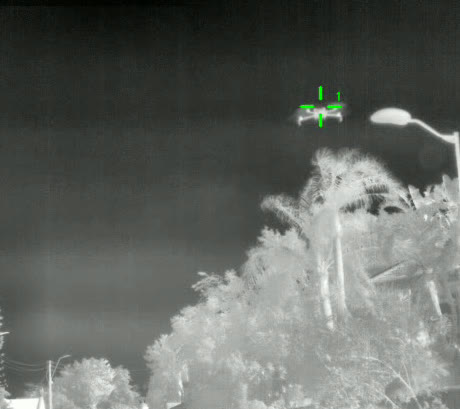
And because the raw sensor frames are archived at the edge, a detection can be re-processed with a newer algorithm after the fact. Last month's borderline event, examined again with this month's brain.
The algorithm improves. The fleet keeps up.
Our detection algorithm is retrained continuously on field data. On its own, that only helps the lab. The hub is what turns it into fielded capability: one action rolls a new model to the entire fleet in about ten seconds — each node pulls it, verifies its integrity, and hot-swaps the live pipeline. No site visit. No downtime. The algorithm your fleet runs in December is not the one it ran in June, and nobody climbed a mast in between.
The reverse direction matters just as much: sensors don't usually fail loudly. They drift — a temperature creeping up, a camera delivering fewer frames each day. The hub keeps the health history of every unit and draws the trend, so a slowly-degrading node is a maintenance ticket this week instead of a coverage gap next month.
Plugged into command, not beside it
The hub speaks SAPIENT (BSI Flex 335 v2) — as a server and as a client. Our detections stream to higher command in real time, and partner sensors plot on the same shared map. We built a detection layer, not a walled garden: your C2, your effectors, your decision.
And because incidents don't wait for you to be at a desk, the whole thing — map, live feeds, alerts, replay — runs on a phone: a native iOS app and an installable PWA.
Why I'm writing this
Because I believe the counter-UAS market has an evidence problem and an operations problem, and both hide behind glossy detection demos — right up until you own a fleet.
If you're responsible for protecting a site, a border, or a principal, ask your current or prospective C-UAS vendor two things: how their algorithm got to where it is (and how it keeps improving in the field), and my four questions from the top of this post. If the answers are vague, the protection will be too.
Ours are here: goteam.co.il/management.html
— Baruch
See the hub with your own nodes on it.
We'll walk you through a live deployment — real sensors, real detections, real C2 feed.